“‘What was most important was what was missing,’ writes Lanzmann in The Patagonian Hare, which was ‘death in the gas chambers, from which no one had returned to report. The day I realized that this was what was missing, I knew that the subject of the film would be death itself, death rather than survival.’ It was the impossible, the great unknown, ‘the presence of an absence,’ in the words of Jewish philosopher and Mauthausen survivor Emil Fackenheim, which could be neither avoided nor dramatized, only endlessly approached.” — Kent Jones, Approaching Shoah
I just finished The Criterion Collection’s awe-inspiring Blu-ray edition of Shoah over the course of a few evenings and wanted to put down a few thoughts here. I want to try and capture my feelings about this film in a way that is completely authentic to my own experience of thinking about it. Apologies if this is incoherent to others; merely an attempt to get my head around an absolute masterpiece.
As you probably know if you are taking the time to read this, Shoah is a non-fiction recounting of the terrible details of the Holocaust, filmed in the 1970’s, looking backward to the 1940’s through the veil of modern, physical context. The film prowls through then-contemporary space to capture what remains, using the immediacy of primary sources– survivors, witnesses and perpetrators– to underscore the importance of making the document itself. The extermination program against the Jews of Europe organized and perpetrated by the German government was a secret, forged on a terrifying combination of efficiency and antiquated technology, and great lengths were taken to erase evidence. Lanzmann’s project is a reclamation of the process of murder and death, “the how,” combing through every available detail to create a cinematic experience; as trains click along through empty forests toward genocidal factories, it is impossible not to hold one’s breath. The steam of the engines, the empty spaces that populate the ruins of the camps, the film presents a visual outline of its narration and, like so much of great cinema, the mind fills in the blanks.
Today, we are another 28 years removed from Shoah’s 1985 premiere, and the world, in all of its physical and sociological manifestations, has shifted and, in so many cases, retreated even further away from the immediacy that Shoah is able to present. In 1985, and when I first saw it in the early 1990’s, time and space served as a palimpsest in the film; change and the passing of time continue to write over the top of the past, the text of now and then intermingling in Lanzmann’s spaces which, overwhelmingly, are quotidian features that served a brutal purpose in accommodating atrocity. Train tracks enabled trains, trees and forests hid camps from sight, roads enabled vans, etc etc.
All of this has inevitably moved even further from the time at which Shoah was completed, and our modern condition– the battle for authority in the age of the internet, domestic and international battles against state and non-state violence, internet surveillance and intelligence gathering, and the democratic, immediate, global access to technology as a way to create and consume information in real time– makes a genocide of steam trains, gas engines, rudimentary gas chambers, brutally antiquated crematoria, and a global (and sometimes willful) contemporary ignorance seem even more incomprehensible. In this way, Shoah has grown in stature and importance, not only as the preeminent cinematic document of the detailed process for the extermination of the Jews of Europe, but as a fundamental reminder that state violence remains a constant, and even more dangerous, threat. And even in that context, one need only look to Rwanda nine years ago (already?) to see how efficient brutality can be in its most analog, terrible forms.
Perhaps most of all, Shoah’s reclamation project feels eternally vital because so many of its voices, the passionate survivors and witnesses (even perpetrators) are no longer with us:
Raul Hilberg, whose book The Destruction of The European Jews remains one of the most important scholarly documentations of the Holocaust.
Jan Karski, who, as a delegate of the Polish Resistance, reported to Allied governments about the Nazi extermination programs and the Warsaw ghetto and was essentially ignored.
Simon Srebnik, who is one of seven reported survivors of Chelmno extermination camp (at which between 150,000-340,000 victims were said to have been murdered in gas vans).
Rudolf Vrba, who escaped Auschwitz-Birkenau and reported on conditions in the camps.
They are gone now, along with so many others who appear in the film.
And those spaces in the film, where monuments now stand? As Lazmann says at the beginning of his film Sobibor, 14 Octobre 1943, 16 Heures (which is one of three subsequent films crafted from the original Shoah interviews that are included in the Criterion edition):
“…museums and monuments instill forgetfulness as well as remembrance.”
The physical reality of the Holocaust continues to fade into the distance of time. As long as there is an audience to pay attention, Shoah makes certain that what could be excavated, memories and spaces from the 1940‘s crafted into a detailed, profoundly evocative cinematic form in the 1970‘s, will never be forgotten. Kent Jones, in the brilliant essay I have quoted above, is right; this material, this subject, and this film can only be endlessly approached. We just have to be sure that we keep wrestling with it. I know that I won’t be able to stop.
Can’t say it better than others, but wanted to express a few thoughts on the controversy surrounding Zero Dark Thirty, Kathryn Bigelow’s new film about the hunt for and death of Osama Bin Laden.
Let’s start here: those who criticize a film without seeing it are contemptible. Literalists who condemn Zero Dark Thirty after seeing it are terrible readers of film. How can art address the murkiness of human morality without showing it?
The film is obviously a composite of many thousands of facts. That it draws a straight line from a CIA officer named Maya (Jessica Chastain) and her obsession with a single name through to the killing of Osama Bin Laden is proof of how much information from the search for Bin Laden has been excised. If there is one complaint I have, it is that a 2.5 hour narrative fiction film is incapable of conveying the overwhelming number of false leads and misleading or insignificant chatter that must have been present. It unavoidably under-represents the problem of the search for Bin Laden in the name of condensing the facts into a story. That is what storytellers must do.
But those who say a film that compresses and composites this much information is an apologia for torture are crazy. The controversy seems centered around a single character in the film, a composite character who signifies black site interrogation subjects, who is tortured and then, under standard interrogation and NOT DURING TORTURE ITSELF, gives a single name that sets off a chain of events that leads to Bin Laden. This, it seems, is what sends cinematic illiterates into a hand-wringing frenzy as they claim that torture never lead to any actionable intelligence that lead to the death of Bin Laden.
“In a secret CIA prison in Eastern Europe years ago, al-Qaeda’s No. 3 leader, Khalid Sheikh Mohammed, gave authorities the nicknames of several of bin Laden’s couriers, four former U.S. intelligence officials said. Those names were among thousands of leads the CIA was pursuing.
One man became a particular interest for the agency when another detainee, Abu Faraj al-Libi, told interrogators that when he was promoted to succeed Mohammed as al-Qaeda’s operational leader, he received the word through a courier. Only bin Laden would have given Libi that promotion, CIA officials believed.
If they could find that courier, they’d find bin Laden.
The revelation that intelligence gleaned from the CIA’s so-called black sites helped kill bin Laden was seen as vindication for many intelligence officials who have been investigated and criticized for involvement in a program that involved the harshest interrogation methods in U.S. history.
‘We got beat up for it, but those efforts led to this great day,’ said Marty Martin, a retired CIA officer who for years led the hunt for bin Laden.
Mohammed did not reveal the names while being subjected to the simulated drowning technique known as waterboarding, former officials said. He identified them many months later under standard interrogation, they said, leaving it once again up for debate as to whether the harsh technique was a valuable tool or an unnecessarily violent tactic.”
Is that not EXACTLY what Zero Dark Thirty expresses, in composite, in its first hour? This exactly? A character who, after being tortured, gives up a name under standard interrogation? I am no apologist for torture, I think there is no moral reasoning under which torture is acceptable, but I think Zero Dark Thirty shows this exactly, and not only that, shows the moral ramifications of this reality in a profoundly meaningful way by expressing the unknown as the unknown. Would Khalid Sheikh Mohammed have given the names up without the precedent of his experience of torture? Does that make any of it right? Can we know this? Art asks these questions; that Zero Dark Thirty tells the truth, whether we want the truth, shows its efficacy as art, treating the viewer like a reasonable adult who should see and decide for themselves. How any thinking person could not see this in the film, especially thoughtful political commentators who know the facts of what happened, is well beyond me.
The fact that the CIA destroyed its interrogation tapes and that the government has buried the Bin Laden death photo gives the film a cathartic, democratic power; we desperately want to imagine what went on in or name. Zero Dark Thirty is thrilling for providing us a space to examine our own place in the war on terror, but it never loses the power of fictional representation to transcend the specifics of reality in the name of heightened, compressed emotion. What else should art do?
EDIT (9:19 PM):
After a spirited discussion with The Guardian’s Glenn Greenwald about ZDT and representations of torture, Mr. Greenwald pointed me to this letter from Senators Feinstein, Levin and McCain (FLM) to Michael Lynton at Sony Pictures. I won’t transcribe the whole letter, but I wanted to address the objections raised against the film.
FLM: “Pursuant to the Senate Intelligence Committee’s recently-adopted Study of the CIA’s Detention and Interrogation program, Committee staff reviewed more than 6 million pages of records from the Intelligence Community. Based on that review, Senators Feinstein and Levin released the following information on April 30, 2012 regarding the Usama Bin Laden operation:
*The CIA did not first learn about the existence of the Usama Bin Laden courier from CIA detainees subjected to coercive interrogation techniques.”
Quickly on this point: ZDT shows exactly this. Well after Maya learns of the courier’s nom de guerre from the “black sites” composite character during a standard interrogation (presented as being post-torture, ala Khalid Sheikh Mohammed), a young agent presents Maya with a file which names the courier and provides his nom de guerre. This is how Maya begins to piece together the courier’s existence despite receiving the false information that he was dead. This moment proves that the CIA already knew about him but, like so many thousands of other pieces of intelligence, the dots had not been connected to other intelligence. So, while Maya first learns of the courier from the KSM composite character, ZDT is clear that information about the courier was in hand at the CIA prior to Maya’s finding out the name. This point is crucial to showing the role of non-coercive intelligence gathering and to the CIA needing to connect information and it, like so much of this (and any) film, is condensed and composited.
FLM: “Nor did the CIA discover the courier’s identity from detainees subjected to coercive techniques. No detainee reported on the courier’s full name or specific whereabouts and no detainee identified the compound in which Usama Bin laden was hidden. Instead, the CIA learned of the existence of the courier, his true name and location through means unrelated to the CIA detention and interrogation program.”
Again, this is what the film depicts. The film shows Maya connecting the name of the courier through non-detainee generated 2002 file she is handed by a young female subordinate. In fact, the “nom de guerre” of the courier is said over and over again, with misinformation constantly being given by detainees, but the courier’s actual name is discovered in the file. Once the name is connected to the nom de guerre, the phone tapping and tracking operation portion of the film is undertaken, with no information from detainees being posited as being relevant, so I am not sure why this is an objection. The compound is discovered by tailing the courier, who is discovered by tapping his mother’s phone, the number of which is found through a bribe of a Lamborghini, the name found in a file, connected to a nom de guerre about which nothing is known until the file is connected.
FLM: “Information to support this operation was obtained from a wide variety of intelligence sources and methods. CIA officers and their colleagues throughout the intelligence community sifted through massive amounts of information, identified possible leads, tracked them down and made considered judgments based on all of the available intelligence.”
Did anyone watch the film? Anyone? This is clear throughout the entire film. Obviously, no two and a half hour fiction film can show all of this classified work, but needless to say, it is a procedural that leaves no doubt that a wide variety of methods were used to get various pieces of information and that connecting that information was a herculean task.
FLM: “The CIA detainee who provided the most significant information about the courier provided the information prior to being subjected to coercive interrogation techniques.”
I can’t answer this criticism because I don’t know who that person is and how their situation/ information may have been rolled into the film’s narrative. But a point here about the words “most significant”: what is “most significant” in the narrative of the film is Maya’s quest. Those who conflate Maya for “the entire CIA” and feel that information that is disclosed to her is new/ relevant, that her awareness of things is somehow the first awareness of things, are not paying attention because the dots are later connected via other methods, and well, I don’t know what to say about that other than I think that is a true misreading of the movie. The film draws a straight line between Maya’s mission and the death of Bin Laden, but that is not a function of its political stance on torture; it is a function of it being a two and a half hour movie. I would advise anyone who cannot separate the way information is revealed in a cinematic narrative from the political intentions of the filmmaker to avoid films like, oh, say, Salò because, well, that’s going to be uncomfortable for you.
FLM: “In addition to the information above, former CIA Director Leon panetta wrote Senator McCain in May 2011, stating:
‘…no detainee in CIA custody revealed the facilitator’s true name or specific whereabouts. This information was gathered through other intelligence means.'”
Yes, as I said, in the film it is a 2002 file (not torture) that reveals his true name, followed by tapping the courier’s mother’s phone after bribing a Kuwaiti informant to get her number, tracking his cell phone on the ground in Pakistan and tailing him to the compound. Never does the film propose that it was anyone in CIA custody or anyone coerced or tortured that named or disclosed the location of the courier. The only other thing I will say about that sentence from Leon Panetta is that, knowing what we know about renditions and the role of other nations in that program, the phrase “no detainee in CIA custody” (emphasis mine) doesn’t foster a lot of confidence.
A quick re-post of this review, which ran in conjunction with the 2011 New York Film Festival. The Lonliest Planet opens in theaters and VOD this week.
The relationship of the individual to the physical world is one of the (my?) great modern dilemmas; how we move in the world, how we find solitude and contemplative space in the age of the internet, how we find the room to unpack what is inside of us– these are questions that plague me on a regular basis. Part of it is clearly my character, but I’ve never been able to clear the decks and find a comfortable balance between my deepest inner desire (the ability to find quiet and just think and be, as obnoxiously self-serving as that sounds) and the pleasure of social stimuli (which, family and friends aside, finds me tracking the ideas, opinions, activities and lives of hundreds of people using social media). If anything, cinema has become my compromise, a form that allows me both a sense of social and critical engagement while also allowing me the chance to retreat within myself and explore my feelings through the dramatic power of movies.
I find the dissonance between my “real” and my “cinematic” selves to be deeply troubling, if only because in my own imagination, the person I think I am and want to be, is more likely the person sitting in a dark room, staring at a screen, mind racing and heart pounding, than it is the man who is working through his days in the service of his tangible loves and obligations. I have not wholly retreated into a fantasy world, and I take great pleasure in so much of my life, but if I am true to myself, my deep affinity for movies is tethered to the fact that they offer me the space to be who I want to be with myself, they allow my mind the space to move between thoughts and feelings, responses and desires and they never ask me what I am thinking or feeling; engaging with movies allows me to just be. That said, maybe I am not who I think I am.
Julia Loktev’s brilliant The Lonliest Planet focuses on the act of walking, of setting out and moving, to create a transformative space. That the film does so while creating a deeply cinematic experience for the viewer only doubles its power for me.
The Lonliest Planet begins with a rhythmic sound– resembling old, battered bed springs under the stress of violent coitus– against a black screen before revealing the naked torso of Nica (Hani Furstenberg), freezing and soapy, standing erect in a rustic shower, awaiting a rinse which soon arrives at the hands of her fiancée, Alex (Gael Garcia Bernal). A general sense of disorientation continues as we slowly learn that Nica and Alex are traveling together, walking from place to place, before landing a guide named Dato (Bidzina Gudjabidze) to escort them through the Caucasus mountains of Georgia. But as the group walks further and further from Dato’s village, Loktev cultivates a sense of dread and vulnerability before a terrifying moment brings about an unexpected reaction from Nica and Alex, transforming not only their relationship but the viewer’s position in relation to the film itself.
The Lonliest Planet
Loktev is a filmmaker of great gifts, using the frame to establish the dynamics of emotion and power (in the interpersonal sense) with an elegant sense of geometry; during their long, often silent hike, the characters are presented in varying degrees of focus, close-up and bokeh, pulling the viewer toward one character and away from another, giving one primacy on the screen while another defers, always against the staggeringly beautiful backdrop of the grass-covered mountains and valleys. Nature serves neither to humble nor augment the emotional give and take of the film, but rather to establish a figurative grid through which the characters walk. It is through the act of walking through space, together and alone, that the drama of the film plays itself out, every gesture and expression the natural result of a quiet, introspective journey that gets fleshed out once the movement stops and the characters set up camp for the night.
In one of my favorite shots in the film, Nica is wrapped in a foil blanket and warming herself next to the campfire. Just behind her, Dato’s pup tent echoes the triangular shape of her seated body, while further back, a remorseful Alex offers another geometric rhyme, smaller, less meaningful, but still present. I was reminded (coincidentally?) of Cézanne’s painting Bathers at Rest, where the angular positions and shapes of the bodies and the features of the landscape become rhymes, full of weight, depth and light. So too with The Lonliest Planet , which uses composition in the service of relationships and unspoken emotions. Loktev’s film is thrilling because of the way she portrays introspection, but also how the faces, bodies and gestures of her characters convey so much more than words ever could. I found the film to be one of the most compelling movies I’ve seen in a long time; a rigorously constructed story of the way love can accidentally fall apart before reassembling itself in a new, diminished way, told without a single false note being struck and with a thrilling simplicity, utilizing the cinema in the service of the sublime.
For the second year in a row, I was able to capture some images at the New York Film Festival Press Conferences. Despite my limited screening schedule, I did see quite a few films, including three films (Holy Motors, Beyond The Hills and No) that I consider to be among the best of the year. This year’s crop of pictures is director heavy, but what can I say, I only made it to the movies I needed to see. So, here is a selective look at the fantastic 50th Anniversary of The New York Film Festival…
It’s Halloween time, need I say any more? This is one holiday that is all about atmosphere, and I am a big fan of setting the proper mood, so please follow this recipe before reading the rest of this post:
…. As a preface, Mussorgsky’s Night On Bald Mountain from Walt Disney’s Fantasia. Give a look…
Play this very loud!
…. Turn the lights very, very low… lower… lower…
…. Make yourself a nice, warm glass of apple cider. Add something stronger if the spirits move you.
…. Scan the room… Is anyone there? Hello? Sorry, I thought I heard something…
Everything set? Ok, there are a few films that I really think deserve a special mention around Halloween, films that deal with fear, fright, and scare the pants off of me. You’ll notice some glaring omissions (Suspiria? Nuh-uh), but to each his own. In honor of 2012, try one of these twelve films for the long, scary nights of the Halloween season. You’ve probably seen them before, but they’re still scary good!
12. Dead Ringers by David Cronenberg (1988)
It Hurts Just To Look: Elliot Mantle’s tool set from David Cronenberg’s Dead Ringers
This one is for the ladies. I have no idea what drugs David Cronenberg takes for recreational purposes, but oh, what I would give to have been a fly on the wall when he pitched Dead Ringers to Twentieth Century Fox…
“Ok, here’s the idea: Twin gynecologists, one dominant and one submissive, trade lovers. Slowly, they develop a co-dependent drug habit which coincides with their development of extreme gynecological tools and botched procedures…”
Cronenberg loves the concepts of penetration and body modification, but nothing he has made is scarier than his use of this theme in medical, and reproductive, circumstances in Dead Ringers. Few movies in history have dangled impending horror more deftly than the moment when Elliot Mantle (one of two roles played by Jeremy Irons) goes to pick up the gynecological tools he has had made. If you can watch the revelation of those tools and not be filled with dread for the film’s remaining run time, well, you’re made of stronger stuff than I.
11. American Psycho by Mary Harron (2000)
It’s Hip To Be Square: Christian Bale in Mary Harron’s American Psycho
That’s right, American Psycho. Wanna know why? Because if you want to see the model upon which the current economic crisis was built, there is no finer cinematic example. This movie is a hilarious and dignified transcendence of its source material (the novel, not the Regan administration), and it also is very, very frightening. Frightening because it is a perfect excoriation of greed, selfishness, and ego run amok; it shows the invisible, moneyed yuppie class for what it truly is. Highlights abound, but Christian Bale’s delivery of nonchalant insanity like “Sorry, I have to go meet Cliff Huxtable at the Four Seasons” and his menacing monologues describing the glories of Whitney Houston, Phil Collins, and Huey Lewis and the News are terrific fun.
I STILL Can’t Get A Table At Dorsia…(100% NSFW)
But at its core, this might be the most politically relevant horror movie of the past decade. Politics have always been at the core of horror films, and with all the debate about “corporations as people” raging in the country right now, no movie distills the psychopathy of corporate “personhood” any better than this one. Of course, you could just watch Fox Business Channel or CNBC and get the same level of insanity, but why not at least have some fun?
10. Nosferatu, eine Symphonie des Grauens by F.W. Murnau (1922) and Nosferatu by Werner Herzog (1977)
The Face: Max Schreck in F.W. Murnau’s Nosferatu
If you EVER doubt Murnau’s mastery of the cinematic form (and how could you?), I suggest a double feature of Sunrise and Nosferatu. The best vampire movie of all time, Murnau’s Nosferatu is a lesson for all film fans in how to generate fear purely in images. The first time I saw Max Schreck’s Count Orlock slowly rising from his grave was in the Bowie/Queen video for Under Pressure; it scared me then, but that was only a small sampling of the horror that awaited when watching the film itself.
As an added bonus, give a look at Werner Herzog’s remake and marvel at Klaus Kinsky’s performance in the role Schreck made famous. Kinsky is so committed to the part, it seems as if he is about to eat everything on screen (including the scenery). Herzog’s remake doesn’t attempt to tonally match Murnau’s film, but then again, how could it? Instead, the film has an oppressively formal feeling that delivers a tension all its own.
9. Poltergeist by Tobe Hooper (1982)
There Is Nothing Scarier Than An Evil Clown: Tobe Hooper’s Poltergeist
As a child, and clearly childhood has a profound influence on my list making, no movie fucked me up more than Tobe Hooper’s Poltergeist. Is there a sequence in this movie that did not make me shit my pants in fear? The killer clown? Check. The trees coming through the window? Check? The woman peeling her face off in the bathroom mirror? Oh my God.”They’re heeere…” Ahhhh!
I can’t really talk rationally about this film, which is my favorite in the “ghost story” genre, because it has left such a huge impression (okay, scar) on my psyche. I think I saw Poltergeist four or five times in the theater, and it scared me to death every time. I’ll never move to suburbia.
I also think this movie is rather under-appreciated as a horror film; because of Steven Spielberg’s involvement perhaps, or because it made shit loads of money, or because it was so accessible to children when it was released and focuses on childrens’ greatest fears– the idea of being separated from our parents and testing their love for us. Will mom and dad come through? Poltergeist puts our innermost fears to the test in a big budget frightening ghost story that I have a hard time watching to this day. Love it.
8. The Texas Chainsaw Massacre by Tobe Hooper (1974)
This Will Not End Well: Tobe Hooper’s The Texas Chainsaw Massacre
The Texas Chainsaw Massacre is the best of the 1970’s horror films, which puts it near the top of this list by default; the 70’s redefined horror for all time, bringing intensity and graphic violence to the service of low-budget, independent filmmaking. After Night Of The Living Dead set the bar, films like Last House On The Left and The Texas Chainsaw Massacre took the disillusionment of the flagging counter culture, its assumptions of innocence and idealism, and put it through the meat grinder of cynicism. For this alone, The Texas Chainsaw Massacre is something of a masterpiece; the film works both as an allegory for the end of an era and as an unfathomably depraved story of the worst family in history. Sure, it also launched an entire genre of films that demonize uneducated rednecks, but that sin is more than absolved by the potent urgency of the film, whose violence comes tortuously slowly and then suddenly, without warning. The triumphant psychopathy of Leatherface at the end of the film, swinging his saw as he dances in that 1970’s sunlight, lens flares exploding on the screen, remains one of the images that has haunted my dreams for decades.
7. The Silence Of The Lambs by Jonathan Demme (1991)
You Covet What You See Every Day: Jodie Foster in Jonathan Demme’s The Silence Of The Lambs
This film is the only one on this list to win the Academy Award for Best Picture, which tells you all you need to know about the power and accessibility of this movie. I took a screenwriting class once where a student proposed a serial killer film and the instructor replied “We have Silence Of The Lambs. How will you surpass it?” (which, terrible teaching, but also, true.) For me, the film is the perfect thriller that takes a dark turn into the realm of horror not with Hannibal Lecter, but with Buffalo Bill (played with devastating perfection by Ted Levine), the film’s main target and its most terrifying character.
Goodbye Horses
Yes, Anthony Hopkins’ rationalism and psychoanalysis is scary for those suspicious of intellectuals (or those who don’t want to be eaten by one–I could write a book on how this character panders to American anti-intellectualism, but I’ll save that), but it is Clarice Starling’s pursuit of Buffalo Bill that drives the film onward and hurtles it toward its amazing conclusion. As much as I want to find something not to like about this movie, and there are so many things that should drive me nuts, it does absolutely everything right. I can’t watch it without being sucked in every time. By the time Clarice rings the right doorbell and dives in to Bill’s world, there is nothing that can pull me away.
6. Halloween by John Carpenter (1978)
The Shape: Michael Myers Haunts John Carpenter’s Halloween
All hail the king of the slasher films. Any horror movie list that does not feature John Carpenter’s genre defining Halloween is essentially worthless; this is the blockbuster that forced studios to invent their own ultra-violent killers, the movie that put the audience behind the murderer’s mask, the movie that picked off over-sexed but otherwise innocent teenagers one by one. The score? A classic. The killer? That white mask will forever be etched in the memory of everyone who saw the film. The heroine? Jamie Lee Curtis at her “scream queen” defining best.
What stands out for me, though, is the way in which Carpenter establishes the tension, using Michael’s slippery presence in slow driving cars, behind bushes, in backyards and schoolyards to set the atmosphere for what is to come. And when it does come, the movie shifts into an entirely new gear, quick and deadly. I was tempted to put in my other favorite Carpenter film, The Thing, here but Halloween remains first and the best.
5. Night Of The Living Dead by George Romero (1968)
Guess Who Doesn’t Die First?: Duane Jones in George Romero’s Night Of The Living Dead
Night Of The Living Dead makes the list for its place as the transformative horror film; there are the movies that came before, and there are the movies that came after. It was also an incredibly transgressive response to the era of free love and Vietnam; graphic cannibalism, an African-American hero, a child murdering her parents and zombies, those apathetic American ciphers, all made a huge impact on horror storytelling while describing the state of world.
There are so many amazing aspects to the film’s story– the non-existent budget, the fact that the distributor naively allowed the copyright to lapse, which inadvertently put the film in the public domain– but ultimately, it is an utterly frightening template for a million films to come. There are better zombie films, but none as important or as primal as this definitive movie.
4. The Exorcist by William Friedkin
A confession: this movie never really scared me all that much. Even as a child, the pacing of the film, the way in which the exorcism itself was carried out, it just felt really rushed and without much depth. We never really got to know Linda Blair’s Regan other than as a helpless child, which strips this story of its emotional stakes for me. But over the past year, watching the film again, I was struck by how deeply I was moved by Jason Miller’s performance as Rev. Damian Karras, the young priest struggling with his own doubts about his faith. I identified deeply with his reluctance to get involved too deeply in the film’s central crisis, until he must at last act; his decision to absorb the possession at the end, that sacrifice, was profoundly moving this time around. I feel like I have been misreading this movie for way too long, always in it for a good scare when, essentially, it represents one of the most interesting onscreen representations of faith I have seen, let alone in a Hollywood movie (God bless you, 1970’s)…
Karras’ Dream
The film has rocketed in my estimation and while it still provides the goods (especially when it works on a subliminal level), I think it has become one of the most important horror films for me, a film that is truly transgressive for its portrayal of religious faith, a transgression that seems to deepen as the years go by…
3. Alien: The Director’s Cut by Ridley Scott (1979)
In Space, No One Can Hear You Scream: Ridley Scott’s Alien
Ridley Scott’s career is, for me, divided into two sections; Alien, Blade Runner, Thelma And Louise and Black Hawk Down (yay!) and everything else (bleh!). People often forget about Alien when thinking about horror films, probably because the film is set in outer space and therefore has been classified as sci-fi. Also, the franchising of the film’s titular monster has only detracted from the reputation of the original film. Let me tell you, when the digitally-projected Director’s Cut of Alien played at the Union Sq. Cinemas a few years back, it scared me shitless all over again. This is one instance where the ‘Director’s Cut’ has resulted in a superior film; the pace is slower, which allows the tension to build and the audience time to explore the insanely creepy sets. There is no movie with better design.
Dinner Time…
It also features a revolutionary heroine, removing horror’s unfortunate trope of women as screaming victims in favor of the proactive badass. Sigourney Weaver’s Ripley would come to define the genre, bringing women into the horror/action fold in a whole new way; Linda Hamilton in Terminator? Carrie Anne Moss in The Matrix? The entire oeuvre of Angelina Jolie? All of them are indebted to Ridley Scott who, despite some films that don’t work for me at all, has proven to be a true feminist and deserves praise for changing the roles of women in these films. But no matter what your opinion is of the film’s gender politics or which edit you prefer, this movie is a masterpiece of tone and storytelling. The dinner scene alone will live forever. Makes you wonder how this man could possibly be the same guy who made Hannibal…
2. Psycho by Alfred Hitchcock (1960)
The Eye: Alfred Hitchcock’s Psycho
True story: At my mother’s 40th birthday party (sometime in the mid-1980’s), a friend of hers she had not seen in decades took to the podium to tell a story of their friendship from 25 years prior. In 1960, the two teenage girls went to see Psycho and they were completely freaked out by it. The next morning, while my mom’s friend was taking a shower, my mom grabbed a knife and snuck into the bathroom, tearing open the curtain and scaring the absolute shit out of her terrified friend. Twenty five years later, the friend was still unable to shower with the curtain closed. That story is not a testament to my mother’s perverted teenage sense of humor (who hasn’t pulled the Psycho gag or had it pulled on them?), but instead to the power of Hitchcock’s movie, which remains a definitive film in the genre.
Most Influential Scene Of All Time?
Not only was it influential in its use of editing and camera (how many of the shots from the film have been stolen? what other movie has endured a shot-for-shot remake?), it remains plausibly terrifying some 51 years later. Hitchcock’s perversity and fetishes are in wicked form here and if the movie doesn’t top my list (it’s not even the best Hitchcock movie), it must come near the top of the discussion because it is an utterly incredible piece of filmmaking made by a master of the form. If only there were another film or filmmaker that could top it… oh, wait….
1. The Shining by Stanley Kubrick (1980)
Oh, Danny Boy: Stanley Kubrick’s The Shining
This is the scariest movie of all time. Period. End of discussion. I think of The Shining as one of those fortunate, perfect moments when an artist’s technique and his chosen subject matter converge into a flawless harmony; this story of a family wrenched apart by a nervous breakdown in a haunted hotel was seemingly written specifically for Stanley Kubrick’s camera. Of course, it wasn’t (Stephen King reportedly dislikes Kubrick’s version), but this movie is an absolute masterpiece. Call me a charlatan, but I think it is Kubrick’s best movie, and that is saying something. Of all the films on this list, it is one film where the camera, slowly prowling around the Overlook, is the most frightening character in the film; it’s as if Kubrick himself is the evil soul of the hotel, showing us precisely what we fear. I could list the shots that will live forever, but i might just have to recite the entire film; the elevators, the twin girls, the sound of Danny riding that Big Wheel across the carpets and hardwood floors, the axe going through the door of the bathroom, the chase through the maze, the haunted ballroom, the corpse in the bathtub, and on and on. The atmosphere of dread in this movie is unfathomably great; no one has come close to duplicating the tension achieved with Kubrick’s simply gorgeous cinematographic style.
Perfection (scene ends at 1’59”)
I will never forget the first time I saw this movie. I can describe the sofa I was sitting on when those elevator doors spilled blood, the color of the blanket I used to hide my eyes when the dead woman sat up in the bath tub, and the memory of sitting bolt upright for the film’s final 30 minutes. I hate to sound fucked up, but I CAN’T WAIT until my kid is old enough to watch this with me. I plan on spending the whole time just watching his face. On a primal level, the idea of the family turning in on itself is utterly terrifying, and this film is the most frightening vision possible of that most intimate of fears. The definition of cinematic horror; a perfect film as far as I am concerned.
Bonus Selection: My Favorite Horror Movie Sequence
The film is not on the list, probably because I saw it too late in life, but Ti West’s House Of The Devil(2009) features my favorite horror movie sequence of all time. Why? It is a perfect representation of the horror tropes of my youth and it is simply a great use of cinematic tension (sound, the editing, earphones blocking out the dangers lurking in the house, the nonchalant dancing a counterpoint to the horror behind the doors, etc). And those camera moves; straight out of the 1980’s playbook! I can’t help but get giddy. Of course, the whole thing hinges on that cut to the black basement, looking up the stairs, the sound suddenly changing to an external reading of the headphone music; this is just brilliant work. It comes at a point in the movie that has been defined by slow, creepy silence, then suddenly, the Sony Walkman (yes!) comes on and a whole new tone is established, equally troubling, with a wink and a smile as well. I just love this sequence, so as a parting gift, here it is. Turn it up! Happy Halloween!
Leos Carax’s Holy Motors is a deeply personal film, the first film of the 21st century to tear apart the modern conditions of filmmaking and expose their ultimate superficiality. I think the film is a masterpiece and will stand as a vital document that describes the challenges and problems facing filmmakers who confront an industry that continues to spiral away from authentic human experience toward a completely artificial, isolated world driven by money, surface and condescension. Not only is this painful realization at the heart of Carax’s film, it is literally its narrative subject; written by Carax in a “rage for being unable to get a film made,” Holy Motors is an incendiary, often hilarious, manifesto in favor of putting human feeling back into the movies.
The film begins with a snippet of a silent film of a human body in motion, which cuts, eventually, to a packed cinema filled with patrons who are sound asleep, dead to the magic of the cinematic image but sitting face to face with the viewer. We soon seen Carax himself waking from a dream (or waking into one) and entering the balcony of a cinema through a secret door. A naked child runs through the aisle, a younger self, the one inside of us of which Carax hopes we are aware, the one he asks we bring to the experience of watching the film, and he is chased by a giant, menacing black dog. This opening is vital to Carax’s point that the cinema has been stripped of its revelatory power, of its history, of being alive to the simple complexity of human experience and action. Carax is trying to restore the magic of the image, to bring a childlike sense of wonder to the proceedings.
Soon, we meet Oscar (Denis Lavant, in a performance for the ages), a businessman who slides into the back of a white stretch limousine and begins to check on the day’s appointments. Suddenly, Oscar begins to transform himself into an old beggar woman, one of many roles he will play during this long day. Oscar panhandles on the streets of Paris and the point is clear that the situation Carax is describing is not the condition of the actor or the condition of cinema, but the condition of the director, the auteur, in the modern business of filmmaking. Here, the artist begins his day by begging for money which, not unlike Carax’s own frustrations with fundraising to make his own films, is a baffling, humiliating process, a “role” that the filmmaker must play in order to continue his work.
M. Oscar
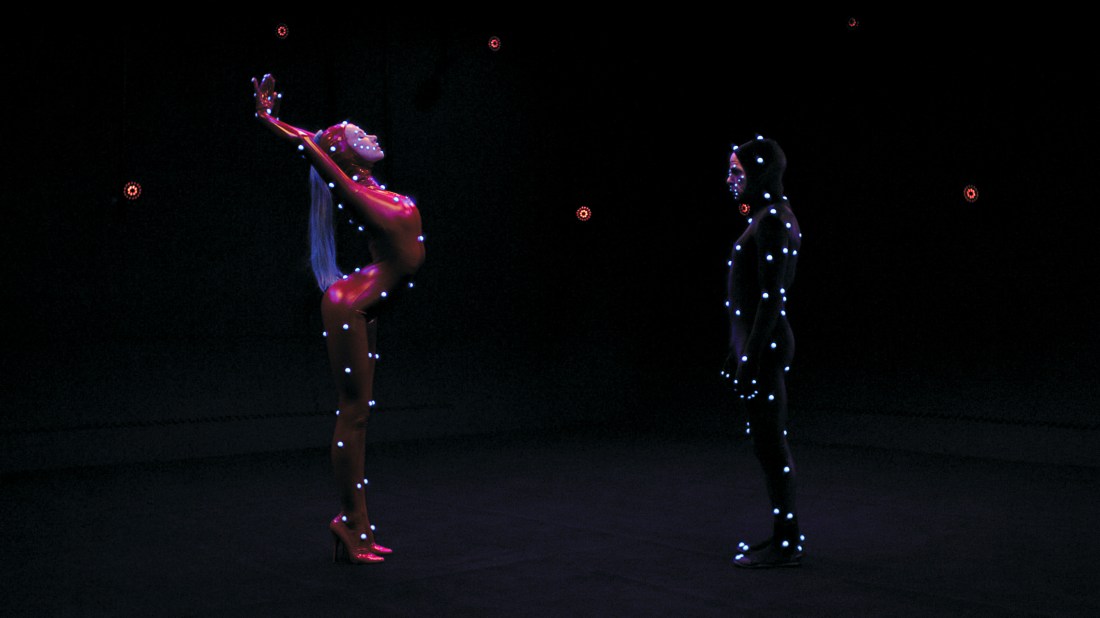
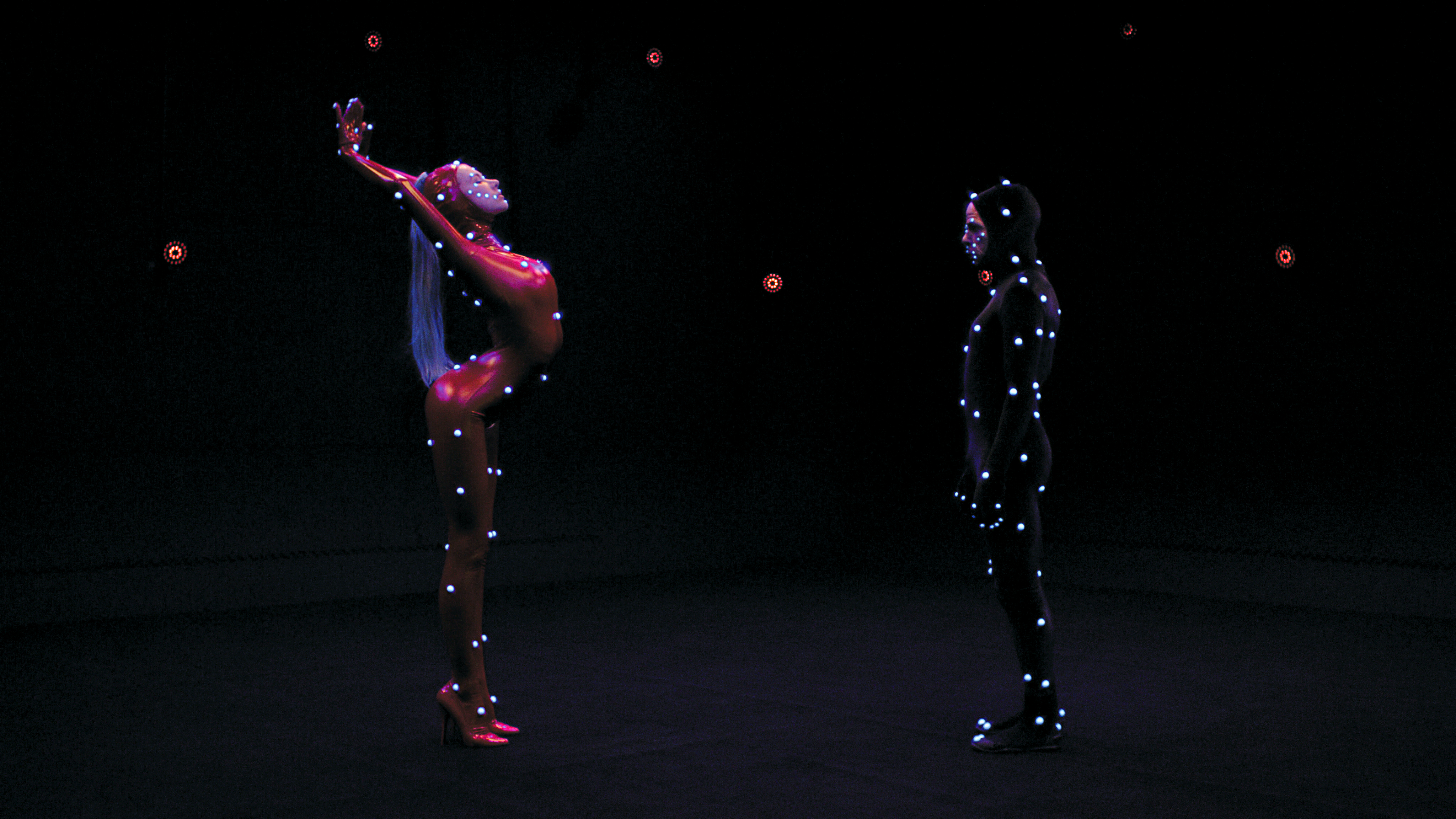
As the film moves along, and as Oscar finds himself in new role playing situations, Carax sets up spaces of action that at once echo the current conditions for filmmaking while, simultaneously, offer a biting critique of their result on filmmaking itself. Take, for example, two of the film’s most memorable juxtapositions– the motion capture sequence and the fashion shoot in the cemetery. In the motion capture sequence, Carax is proposing that filming the very human act of motion capture itself is far more interesting for its physicality and action than the animations and artificiality that result from the process. He is right; in a sequence that pulsates with erotic power, watching Lavant and Zlata Contortionist writhe in unison is absolutely unforgettable.
Motion Capture
In an appointment that soon follows, Oscar arrives at the Pére Lachaise cemetery as a wild grotesque (think Quasimodo) and, alert to the staged, exploitative ridiculousness of a fashion shoot taking place amidst the tombstones (which, hilariously, offer URLs for the websites of the deceased), kidnaps the model Kay-M (Eva Mendes) and steals her away into the sewers of Paris, where he rearranges her clothes into a burka before releasing her back into the world. Never has celebrity and the artificiality of desire been so wonderfully neutered. And what more to say about the moment when Oscar stops the limo and, in an improvised moment of clarity, plays the role of the art terrorist who puts a bullet in the brain of a banker found dining al fresco in a café? This being the artificial world of the film business, Oscar survives death without a scratch, and carries on to his next role. The film continues forward with the momentum of a wildfire, each situation connected to the last by Oscar’s place in it and its relationship to Carax’s central argument about the roles the artist must play within his own life in order to work and live.
Fashion
There is more; Oscar meets Eva Grace (Kylie Minogue) who, like he, operates in the world of role playing and artificiality. She is on her own assignment (a stewardess at the end of a love affair) and as Oscar talks with her, their shared feeling is expressed in song and in dialogue. It is clear that this is Eva Grace’s final assignment and, when Oscar departs the abandoned department store where they have had their rendez-vous, he finds her and her lover splattered on the sidewalk. The suicidal act, seemingly her only escape route, sends Oscar screaming back into the limousine, his self-recoginition in this brutal end too much to bear.
Eva Grace
In the film’s most moving sequence, Oscar plays the role of l’mourant and meets a young woman in a hotel chamber where the two discuss their secrets. This scene is the deathbed conversation between Ralph and Isabel lifted directly from Henry James Portrait Of A Lady, and in it we get a glimpse of true feeling between characters on the big screen. But it is important to remember the conditions taking place in this reference; Ralph has known all along that Isabel’s husband didn’t love her, that he married her for the money and here, as Ralph lay dying, Isabel finally sees it too. In the novel, Ralph is the observer who sees the truth, a man whose illness prevents him fully participating in the joys of life but allows him access to understanding that others do not have. Isabel’s exploitation finds its opposite in the love the cousins share with one another, but it saves neither of them from their ultimate doom; money, exploitation, disease and obligation win out. But here, in this one moment, there is the simple comfort of acknowledgement, of saying aloud and finally hearing the truth, which is exactly the comfort that Holy Motors itself provides. At last, the truth is spoken and nothing will ever be the same.
After going 4-4 in my Quarterfinal predictions, I am confident that I am due to get one of these wrong. But here we go anyway… my semifinal predictions. Run of the mill, but I have to follow my gut.






 The Back Row Manifesto