Euro 2012 | Preview: Group C

Euro 2012: GROUP C PREVIEW

Your international footballing history fact of the day: no team has ever won a European Championship, a World Cup and another European Championship consecutively. In fact, no team has won back to back European Championships, never mind a World Cup in between. The only team to have come close to that feat was Germany; in 1972, Germany won the Euros, followed by a win in the 1974 World Cup, only to lose on penalties in the final of the 1976 Euros to Czechoslovakia (ouch).

But history may be in the cards for 2012; Spain stand poised to become the first European team ever to win three consecutive major international trophies. Hard to bet against them; once again, they look the favorites to win it all. I have my suspicions; having relied heavily on the goal scoring touch of the great (and now injured) David Villa and carrying a front line missing Villa’s clinical edge, Spain have some questions to answer. Questions like “where will the goals come from?” You know, important questions. And of course, there are fifteen other teams in the tournament looking to knock them out, and three members of their Group who would be thrilled to take points off of the defending champions. There is no easy path to the trophy, but still, Group C is likely to be a case of Spain and the also rans, a battle for second place among three interesting teams with a lot of history.

The Teams

Croatia

Personally speaking, Croatia are one of my favorite teams to watch, primarily because of their rock-and-roll manger Slaven Bilić. Bilić is the kind of man who seems to both love football and to not care at all about what the world thinks of him, his methods, his approach to living*. Despite not having a world beating side, his teams play attractive, attacking football, driven by their playmaking Mr. Everything Luka Modrić. Modrić plays simple, elegant must-see football, both for his home club of Tottenham Hotspur and with Croatia, and his fluent passing game creates openings for attack from players as diverse as Bayern Munich’s Ivica Olić (who is fearless and direct in attack) to the surprise of the professional season, Everton striker Nikica Jelavić (who has a brilliant eye for beautiful, timely goals). Add in a roster of veterans like Dario Srna ans Josip Šimunić and you should have a real contender. All of that said, Croatia have been underachieving of late, needing a qualifying playoff win against Turkey to make it to the tournament, while pre-tournament friendlies against Sweden (a 3-1 loss) and Norway (a 1-1 draw) have not provided any answers. Still, you can’t help but feel Bilić will keep the team loose and in the thick of Group C.


Croatia’s Manager Slaven Bilić enjoys some down time

Italy

Uh oh. The Italian national team is once again in… wait for it… crisis as a new generation of players look to make their mark on the Azzuri. Let’s flash back to 2006, when Italy was ensconced in a betting and match fixing scandal that ripped through their professional league. That controversy galvanized an uncertain Italian side and drove them to a gritty World Cup title. Well, here we are again; authorities have been making inquiries and arrests in yet another match fixing scandal in Italy**, the team have been shaky in recent months and all signs point to problems. Despite dominating in qualifying, it has been a bumpy road to the Euros for the perennial powerhouse, with three consecutive losses to Uruguay, The USA (hooray!) and a 3-0 pounding last week at the hands of Russia. The team that once boasted of its Catennaccio (which literally means “door-bolt”) is now young, hungry, full of inexperience and leaking goals. But don’t be fooled; Italy’s roster is deep with talent and besides, who cares about experimental friendlies? Basta! With antiquated veteran playmaker Andrea Pirlo pulling the strings, bulldog midfielder Daniele De Rossi providing the bite and talented attackers like Antonio Cassano and Mario Ballotelli (about whom more in a moment), there is plenty of fight left in the Italian side. Look for them to be competitive in every match, fighting for a place in the knock out rounds. Can they triumph over scandal again? This one will be very interesting…


The Catenaccio System: Italy Lock The Door To Win

Republic Of Ireland

Full disclosure: I will be supporting The Republic of Ireland during Euro 2012. With that out of the way, this is a team that has put together some nifty results in recent months; the team are on a fourteen match unbeaten streak (without a loss in 15 of their last 16) and are looking sharp heading into the tournament. They also hold a recent win over Italy (2-0 last June) and drew with fellow Euro teams Russia, Czech Republic and, interestingly, Croatia in the past few months. What does it mean for the tournament? Well, I’m hoping that Ireland can ride their luck (see what I did there?) and get some results, but I don’t have a great feeling. What worries me is that, while the defense has been solid, Ireland have not exactly been banging in the goals; looking at their results, there are a lot of 0-0 draws that might have gone either way. Plus, a strike force of Shane Long, Robbie Keane and Kevin Doyle aren’t exactly the types to put fear in the hearts of opposing defenses. In order to advance, Ireland are going to need to win one, draw one and keep the score down against Spain. It’s not exactly mission impossible, but if they can continue to stay in matches and nick results, they have a shot at surprising. But without goals? No chance.


Ireland 2-0 Italy: A Sign Of Things To Come?

Spain

The defending European and World Champions need no introduction, but I have to say something, so let me put aside a few things. First, the midfield of Xabi Alonso, Andrés Iniesta, Xavi Hernández, David Silva, Cesc Fabregas, Santio Cazorla, Juan Mata and Sergio Busquets is, quite literally, the epitome of vomit-inducing greatness. Most teams will not touch the ball against that group; small, simple, elegant passing, the ball pinging back and forth into space, will drive opposition players into tears of frustration and exhaustion. You cannot put that group into words. That collection of players is likely the best ever. Only 4-5 of them will start a game, though.

At the back, Iker Casillas is an all-universe goalie whose substitutes, Victor Valdes and Pepe Reina, are world class, each a guaranteed starter on almost any other team in the world. Defenders Sergio Ramos, Gerard Pique and Alvaro Albiloa are outstanding in defense, converting defense into attack, and playing their part in ball possession. Who can stop Spain?

And yet… look toward the attacking end and you start to see some problems. Fernando Llorente, a classic center forward, plays a very specific type of game, one that demands aerial service and patience. Fernando Torres is coming off of the worst form of his life, his confidence seemingly destroyed by a string of injuries and a lengthy spell as a bit part player at Chelsea. Álvaro Negredo scores for Spain… when he gets on the field. And Pedro Rodriguez is a classic #2 man, mopping up with goals and assists when given the chance. What’s missing? David Villa. The Barcelona striker has been the model of consistency for Spain for the past four years, but a serious injury this season has ruled him out of the Euros. So, who will step up and replace Villa? Who among the strikers can claim the goals? With the rest of the team flying, will it matter?

The only chance opponents have against Spain is to press hard when you can, play organized lights out defense and counter attack with efficiency; if you concede the ball to them, sit back and try to defend, it’s game over and lights out. If you can squeak a goal and disrupt the Spanish strikers with tough, physical play, you may have a chance. You have to get them frustrated, press them, force a mistake and then you have to be clinical and punish it. Then? Maybe you have a chance. Maybe. Look for Spain to advance from Group C, but sit tight as they try to run the table and make history by repeating as Champions.


Spain: Once The Underachievers, Now The Dominant Force

Must See Match

While I am tempted to say that any encounter between powers Spain and Italy is must-see (and it is), I have to go with Croatia vs Italy on June 14th as the match I am looking forward to the most. It features two very different styles of play and a great midfield battle between Di Rossi/ Pirlo/ Marchisio against Modrić/ Srna/ Pranjić. Pulling for a draw in this one; if Ireland can hold it down against Spain and get a win and a draw from Italy and Croatia, I like their chances to advance.

Players To Watch

Spain is full of amazing players, Ireland grit and determination and Croatia attitude and dynamism, but there is only one player that is appointment viewing in my home and that is Italian genius Mario Balotelli. Words cannot express my appreciation for him, his joy for life and his utterly refreshing approach to the game. Football is full of cliches, players who make boring statements when they talk at all, media darlings who live in a bubble. It can create ultra talented kids who are arrogant, who become millionaires very young, who are told of their exceptionalism their entire lives. For me, Balotelli is a completely different individual, a mix of punk rock nihilism, talent and privilege that is unique in sport. If you can get past the media cliches, you begin to hint at the greatness of Balotelli. Let’s take a look at his greatest hits:

The Warm Up Bib

Magic In The Luxury Box

Why Always Me?

Press Conference Crasher

But in all honesty, the antics would be bullshit without the skills, and Balotelli is one of the best young footballers in the world. If he can keep his head about him, which he can’t, but if he can, he won’t, but if he can, he can be scary good. It’s the combination of talent and crazy that makes him one of my favorites. I’ll be watching every time he steps on the pitch.***


Balotelli: Real G’s Move In Silence Like Lasagne

Group Prediction

It has to be Spain, and as much as I hope for the Republic of Ireland to pull off the shocker, I think Italy will pull themselves into the knock out stages, with Ireland and Croatia battling them closely for the second spot. Second place is really up for grabs here and I wouldn’t be surprised to see anyone take it, but I have to go with Italy’s talent in the end.

*Group C seems to be the home of free spirits this time around.
** Another sign that FIFA and UEFA are a joke. How can this keep happening?
***Balotelli has also made some provocative statements about confronting racist fans at the Euros, about which, more in another post coming soon.

Previously
Group A Preview
Group B Preview

Euro 2012 | Preview: Group B

Euro 2012: GROUP B PREVIEW

In my Group A Preview, I described the concept of the GROUP OF DEATH as

“a gathering of four teams so alike in stature and potential that any one of them might go on to win the group or miss qualification for the knock out stages. These groups usually feature perennial powerhouses, each a favorite, each impossible to look beyond. The GROUP OF DEATH means thrills, uncertainty, triumph and heartbreak. You can’t look away, each match having the potential to be a classic.”

Well. Welcome to the Group of Death, Euro 2012 style.

Group B has all the makings of greatness, with two of the tournament favorites, Germany and The Netherlands, battling it out for supremacy alongside an historically strong but underachieving Portugal and 1992 surprise winners Denmark (who actually beat Portugal and won Group H in qualifying). This should be a lot of fun to watch, with two of the best teams, perhaps the in-form striker in the world right now and the best European player of the season all colliding in a single group. Let’s get to the previewing, shall we?

The Teams

Denmark

Denmark are a strange team. Yeah, I said it. On the one hand, they are organized, disiciplined and have some very good players; defender Daniel Agger (homer alert: he plays for my Liverpool side at club level) and the exciting young talent Christian Eriksen of Ajax are the types of player that can turn a match with a bombing run forward or a beautiful ball from nothing. On the other hand, you watch Denmark play and the game often falls to the team trying to get the ball to striker Nicklas Bendtner, who can score but who is often isolated in attack. The result? Inconsistency and a lack of fluid play in the midfield creates frustration, until a moment of brilliance, seemingly from nowhere, saves the day. Unfortunately for the Danes, Group B won’t allow any “get out of jail free” cards; too much quality in the Group sees Denmark struggle.


Denmark’s all-ink frontrunner Daniel Agger

Germany

Tipped by many as finalists at worst, winners at best, Joachim Low’s fluid, powerful German side have all the makings of a real contender. I am sure I could sit here and make jokes all day about how Germany are “mechanical” and “methodical” but the fact of the matter is, this is not your father’s Germany. Full of flair and chemistry, Low’s Germany team have many ways of beating you; in the air, on the ground, from crosses and through balls, set pieces and counter attacks. Just ask Group B rivals The Netherlands, who played a friendly with Germans back in November and took a 3-0 beating. One of the great things about watching the Germans play is the dedication of each player to his role in Low’s system; Lahm’s sweeping runs, Ozil’s patient and beautiful passing, Muller’s arrival at just the right moment, Schweinstiger’s control and disruption, Neuer’s distribution. Everyone on Germany plays just the right part, and I expect big things from them in this tournament. Of course, there is one major stumbling block on the way to glory, it’s probably…


Joachim Low keeps Germany ticking

The Netherlands

Nobody is scoring goals right now like Robin van Persie; a classic center forward in every sense of the word, the Arsenal man has been unstoppable leading the line for his club and country. When you add a playmaker like Inter Milan’s Wesley Sneijder and the pace and skill of Bayern Munich’s Arjen Robben into the mix, you have the makings of a deadly attack. Of course, that has never been a problem for the Dutch; it is the back line where the Oranje have had a few concerns. Yes, the team are filled with quality players at every position, but somehow, the Dutch always seem prone to the sucker punch; look at their recent 2-1 loss to Bulgaria for the most recent example of the counter attack causing this team agony. Of course, they can also play lights out, dominate the ball and they remain the best team never to have won the World Cup (losing the most recent 2010 final to Spain). Their match against Germany in the group stage will be the true test of the team; win that match, and suddenly, the Dutch will be looking like contenders to lift the trophy.


You down with RVP? Yeah, you know me…

Portugal

Portugal begin and end with one man, the most prolific European goal scoring machine of the past few years, Cristiano Ronaldo. When he is not battling Lionel Messi for the La Liga scoring title with Real Madrid, Ronaldo is turning in disappointing performances for his national team. For some reason, mental or tactical, I am just not sure, Ronaldo never turns it on for his country in the same way he does for his club. One factor is obviously that, at Madrid, he is surrounded by world class players in a league without much parity. When playing for Portugal, Ronaldo is surrounded by good players who just can’t seem to put it all together. This team are no exception; their form coming into the Euros is poor (0-0 with Poland and Macedonia, losing 3-1 to Turkey), their qualifying campaign was bizarre (a 4-4 draw with Cyprus, losses to Norway and Denmark) and they just don’t seem to gel as a team. Without a true #10 in the midfield to connect the play between the attack and defense (show pony Ricardo Quaresma wears the 10 for Portugal), they look lost. Unfortunately, Group B is not the place to go looking for an identity. Disappointment looms.


Ronaldo scores goals. Lots of goals.

Must See Match

Is this even a question? Irresistible force, meet immovable object. It has to be Germany vs The Netherlands on Wednesday June 13th. Few Group stage matches ever feature this level of excitement. These two teams will bring down the house– position by position, player by player, they are about as equally matched as any two teams in the Euros. Any other year, this might be the final. It still may…

Players To Watch

Group B features several all-universe players– Ronaldo, Van Persie, Sneijder, Robben, Ozil– but one man who will likely be the one to decide the fate of his team is Germany’s Mario Gomez. The Bayern Munich striker is the definition of the poacher, always seeming to pop-up in the right place at the right time to grab a vital goal. That said, he runs super hot and, suddenly, super cold; hardly the most technically gifted player, Gomez can switch from assassin to absolute donkey at the drop of a hat. He’ll have some of the most incredible misses you’ll ever see, only to follow them up with a 93rd minute tap in to win the match. If Germany can get Gomez going, watch out; if he struggles, there may be others to pick up the slack, but it will take some doing to go all the way without him at the top of his game.


Mario Gomez: He Scores When He Wants To

Group Prediction
I like Germany to win the Group, with The Netherlands right behind them into the knock-out stages, Denmark to nick third against a very disappointing Portugal.

Previously
Group A Preview

Euro 2012 | Preview: Group A

Euro 2012: GROUP A PREVIEW

Every international football tournament has its so-called GROUP OF DEATH, a gathering of four teams so alike in stature and potential that any one of them might go on to win the group or miss qualification for the knock out stages. These groups usually feature perennial powerhouses, each a favorite, each impossible to look beyond. The GROUP OF DEATH means thrills, uncertainty, triumph and heartbreak. You can’t look away, each match having the potential to be a classic.

At this year’s Euro 2012, Group A is not that group. On paper.

Instead, Group A features four teams of relatively equal quality but none of whom seem prepared to light it up. In fact, if anything, each of the teams, save one (Russia), are generally unsung, and none are tipped heavily to win it all. If you didn’t know any better, you might call Group A the GROUP OF MEH; looking up and down the group, looking at the player names and team expectations, you have all of the makings of a competitive group with none of the big time fireworks on the pitch.

It should be a different story in the stands, however. If you take geopolitical history into account, and it is hard not to with a tournament like Euros, you can expect the supporters to have another opinion altogether. Russia vs Poland? Russia vs Czech Republic? Russia vs Greece? Czech Republic vs Poland? Hello! Could you have drawn a group with more history? Add Poland’s hosting of the tournament (the atmosphere should be absolutely teeming with hostility during their matches) and suddenly, Group A becomes a must-see, even if the teams are not favorites.

That said, these are the Euros, the one tournament where underdogs have shown they can win it all. Think of Denmark in 1992 or Greece in 2004, teams that came from nowhere to put together a month of miracles and take home the most competitive trophy in international football*.

The Teams

Czech Republic

For me, Czech Republic are simply a high quality team without a focal point. Always organized and featuring recent Champions League Final hero Petr Cech in goal, the Czechs will always field a competitive team. But as the older generation of players (striker Milan Baroš, midfielders Jaroslav Plašil and Tomáš Rosický all in their 30’s) starts to make way, there is a sense that the side are missing a cutting edge creator. They will be bolstered by Rosický’s return to full fitness and left back Michal Kadlec is a star in the making**, but after squeaking their way into the Euros through a playoff with Montenegro, the Czechs are a team walking the line between surprise and disappointment. This Group helps them, no question; they will be looking at each match as one in which they can compete, but they are a longshot for me to make it out of the Group stage.


Envying goalie Petr Cech’s helmet, Czech defender Michal Kadlek gets fitted for a protective mask ahead of the Euro 2012

Greece

Greece won the 2004 Euros… let me type that again, because I still can’t believe it. Greece won the 2004 Euros with a style dependent on tough, organized defense and set piece driven, counter attacking football. They are the football equivalent of the rope-a-dope fighter, absorbing blow after blow, before delivering a knockout punch of their own. They are not pretty. They are not fun to watch (especially, I assume, if you are a Greek supporter), yet somehow, some way, they seem to grind out results. They won their qualifying Group with a series of gutsy performances, the most important of which was a 2-0 win over rival Croatia that featured fans throwing molotov cocktails, smoke bombs and flares at one another. Fun times. Their recent 1-0 win in a friendly against Armenia saw them miss two penalties; even when it should be easy, it’s not. Defender Kyriakos Papadopoulos has scored 3 goals in eight matches, with stalwarts Fanis Gekas, Giorgos Karagounis and Giorgos Samaras typically inconsistent in recent months. Expect grinding football. Rise and repeat.


Greek and Croatian supporters clash during Euro 2012 Qualifying

Poland

The hosts. Never discount the hosts. The hosts always do well, generally qualify for the knock out stages and, since every one of their matches is literally a home match, with swirling crowds and pure intimidation, they stand a better chance than most of qualifying from the Group. And yet… even without the automatic bid as hosts, Poland are a serious threat in the group. Most importantly, they feature of a trio of players who have worked wonders together at the club level; Robert Lewandowski, Jakub “Kuba” Blaszczykowski and Lukasz Piszczek all play together for German woinder club Borussia Dortmund, the back-to-back Bundesliga Champions and they, like their club, are having the time of their lives on the pitch. Lewandowski is on fire, scoring 22 for his club and banging them in for his country as well, with Blaszczykowski a constant threat in the midfield and Piszczek leading the defense. If the rest of the team can play at the level of Lewandowski and company, this seems to me to be Poland’s best chance to make a dent at the Euros in a long, long time and, with the support of the nation behind them, they have a real chance.


Lewandowski is on fire, but the soundtrack is not.

Russia

Russia are, for me, one of the dark horse teams of the tournament. They come into Euro 2012 looking sharp; having pounded Italy 3-0 in recent days and featuring a group of in-form players who are clicking under Dutch manager Dick Advocaat, Russia is certainly poised for a breakout. It may not be a surprise, since they were semi-finalists in Euro 2008, but there is something about them right now that has me thinking big. Still, if anything, the team are once again missing a dominant #10 as the disappointing Andrey Arshavin, whose performances at Arsenal have been lacking when they’ve happened at all, can often go missing; he scored no goals and only had two assists in qualifying. Still, football remains a team game and Advocaat has Russia ticking right now; if they can sustain their performance against Italy into the tournament, look for them to make some waves.


Russian manager Dick Advocaat. Clinical.

Must See Match
For me, it must be Russia vs Poland on Tuesday, June 12th. This match has all the making of a barnstormer, with lots of attacking play and plenty of historic vitriol to fuel the passions of supporters. It is, of all the games in the Group, the one match where I expect sparks to fly.

Players To Watch
Poland’s Robert Lewandowski is everything you want in an in-form striker; he has been scoring goals in bundles and with the chemistry he shares with his club mate “Kuba” Blaszczykowski, I am expecting him to lead the Group in goals. The other contender is Russian striker Aleksandr Kerzhakov who has followed a simple plan in the run-up to the Euros; when he’s on the pitch, he scores goals and sets them up. Simple as. The Zenit striker was not invited to Euro 2008, so my guess is that he is poised to do some damage this time around.


No shirt, but service: Russia’s Aleksandr Kerzhakov

Group Prediction
I like Russia to win the Group with Poland to qualify on a final day must-win against the Czechs.

*Sorry World Cup, but 32 teams makes for a diluted field. Team for team, group for group, the Euros are a tighter, tougher tournament.

** Kadlec likes to party; rival fans broke his nose in a nightclub last month. No, really.

The 2012 Sundance Film Festival | Preparations

January. The annual trip to Park City, UT for the Sundance Film Festival. I have attended Sundance since 1998, with a few years’ absence here and there, and I consider it the most important business trip I make all year. By now it is news to no one that the entire independent film business descends upon (or ascends, I guess) Park City for the festival and because of that critical mass, Sundance serves as a sort of convention for the low budget film business, a cold, exhausting convention full of familiar faces and heavy competition among buyers, critics, film programmers and festival organizers for access and the top films at the festival.

This year, I will be covering Sundance on the Filmmaker Magazine blog, so I hope you’ll follow me over there; you can find Filmmaker on Twitter by following @FilmmakerMag, which I assume will post updates. I’ll also be tweeting from my @BRM account.

As for the blog here, I hope to use this as a home for the pictures I’ll be taking; I’ll have my camera in tow and hope to get some great shots of life at Sundance. I doubt you’ll see any celebrities on here, but I hope to post pictures often. The Twitter feed is updated by this blog, so you can grab the RSS Feed or simply follow me on Twitter to keep up with goings on here.

Off to stuff clothes into a bag. Flight in the morning. The adventure begins….again…

Notebook: ONCE UPON A TIME IN ANATOLIA by Nuri Bilge Ceylan

Once Upon A Time In Anatolia, the latest film from Turkish auteur Nuri Bilge Ceylan, opens with a shot of an obscured pane of glass, a dirty window leaking light and motion onto its greasy surface. Focus pulls us past the hazy façade and inside the kitchen of an auto repair shop; three men sit together, enjoying a joke and eating some dinner. Outside, a dog barks, drawing one of the men outside with a plate of bones. As the dog enjoys his treat, storm clouds gather overhead, threatening. The sense of dread is palpable; despite the good humor, nothing good will come of this. And nothing does.

Once Upon A Time In Anatolia is a remarkable film and, in my estimation, a contender to be remembered as a masterpiece, the second contender I have seen at this year’s New York Film Festival. ‘Masterpiece’ is a word I do not use lightly, and one I reserve for films that have shaken me to my core and displayed a depth of artistry and feeling that is incredibly rare. Yes, we live in an age of hyperbole and yes, the thrill of the new can sometimes overwhelm our ability to recognize what will last, but there is something about Ceylan’s work that transcends. Here, and not for the first time, Ceylan’s incredible gifts as an image maker are put to the service of a complex, multifaceted story that is surprising for the simplicity of its premise and the vast richness of its execution.

Like the filthy glass of the opening shot, the men who populate Ceylan’s latest film are external surfaces betrayed by the complexity that escapes from within them, unconsciously and with tremendous force. Masculinity has always been a crucial subject for Ceylan; from the impossibility of male communication in Distant, to the callous, violent sexual vanity on display in Climates, to the corruption of the individual by his duty that sets the fates in motion in Three Monkeys, Ceylan has always understood the emasculating brutality of power and the impact it has on the lives of men who desire and feel bound to its tropes.

After its ominous prologue, the film continues with the first in a series of expansive widescreen shots of the Turkish countryside; from a distance, we see the headlights of cars as they wind their way along the narrow road. Soon, they arrive at their destination and their purpose becomes clear; there has been a murder and the police, coroner and prosecutor are accompanying the confessed killers in search of the body. Told over the course of a single night and morning, Once Upon A Time In Anatolia spends its time in search of both a body and something far more intangible: the nature of masculinity and its corruption.


Once Upon A Time In Anatolia

Once Upon A Time In Anatolia is bursting with examples that range from the haunting to the hilarious, the mystical to the mundane. In one fleeting but prescient moment, lightning reveals ancient faces carved in the rock, frightening totems of forgotten men who once populated the now barren landscape; in another, the prosecutor, describing the scene of the crime, compares the face of murder victim to that of Clark Gable before a flood of (clearly anticipated) compliments come flooding back his way, bringing a blush to his cheek. Each of the men in Ceylan’s party seemingly want to be someone else, want to be free from the ties that bind them.

This might seem a simplification, but gratefully, Ceylan is far too gifted a filmmaker to simply lay his cards on the table. Instead, Once Upon A Time In Anatolia is sculpted magnificently by the passing of time, by desire. As the night moves forward, into the gloaming of the pre-dawn hours, the disorientation of the search manifests itself in a small village where the party seeks respite. Here, the mayor of the town welcomes the men, allowing his beautiful daughter to serve them tea during an unexpected blackout; as the men drift in and out of sleep, ghosts begin to appear and the daughter begins to haunt their dreams. This loosening of time and its disorienting effect on the party allows them to begin opening up to one another, to begin making confessions, to transform their relationships. It is a bravura sequence, full of hallucination and feeling, that sends the film hurtling toward its heartbreaking conclusion.


Once Upon A Time In Anatolia

Structurally, Ceylan has filled his film with rhyming moments and symbolic images and gestures, none more important than the windows that constantly frame and disconnect people from one another. A pane of glass is a potent symbol for a filmmaker (and, in Ceylan’s case, a photographer) seeking to capture the complexity of life from one side of a lens, and Ceylan uses the divisive power of the window as a way to restrain his characters to hold them back from reaching what they truly want. The film’s final shot brings it home in an immensely moving way; as the coroner looks out the window of his operating room, he watches a mother and her young son walking down a path. Children play in a schoolyard and the boy seeks to pull away and join in the fun. A reversal of the film’s opening shot, the camera generously pulls us in, but the action offers another thought; a sense of loss, of regret and what may be to come.

Like all great art, Once Upon A Time In Anatolia seems to be operating on a million levels all at once; the film clearly deals with class, with the corrupting power and self-delusion of authority, with urban and rural cultural expectations, with the narrow distance between a murderer and a man whose narcissism causes a death of its own. Ceylan has made great films before; perhaps, like me, you feel he has made them exclusively. But with each new movie, his mastery of the form seems to expand, enriching his cinema with an otherworldly, poetic power that I find absolutely gripping. Once Upon A Time In Anatolia stands alongside the finest work in contemporary cinema, a thrilling example of a director in full command of his copious gifts.

The 2011 Toronto Film Festival | Interview: Frederick Wiseman (CRAZY HORSE)

Created over a career that spans six decades, Frederick Wiseman’s brand of non-fiction filmmaking is notable for both its breadth of subject and its disciplined style; no interviews, no narration, just a strict mandate to capture human interactions and then craft them into dramatic stories in the editing suite. If you were looking for a map of human activity in the late 20th and early 21st centuries, you could do much worse than looking at Wiseman’s portraits of our social institutions. His new film Crazy Horse played at this year’s New York and Toronto Film Festivals. I sat down with Wiseman in Toronto, where we met to discuss the film and his career.


Frederick Wiseman (photo by John Ewing)

BRM: To begin, I’m interested to know how you got involved with The Crazy Horse nightclub. I know you’ve made a lot of films in Paris and have spent some time there; what attracted you about that institution or made you want to address it?

Frederick Wiseman: A couple of things really. I’m interested in dance; if you count Boxing Gym, which is at least in part a dance movie, this is the fourth dance movie I’ve made. Ballet, La Danse, Boxing Gym and now Crazy Horse. It’s also another excuse to stay in Paris and that’s not an incidental reason, but in terms of the films that I’ve done, a lot of my films, in one way or another, have a particular emphasis on aspects of the body. Obviously, any movie is about the body; the monastery movie I made Essene is in part about the denial of the body, Hospital and Near Death are about the wasting of the body through illness, disease and ultimately death, Domestic Violence I &II are about the abuse of the body, Boxing Gym is about controlled violence toward the body, Maneuver, Basic Training and Missile, the three military films, are about the body in the service of the state, used to protect the interest of the state, Model is about the aestheticization of the body to sell commercial products, The Store is about the adornment of the body– so, in an abstract way, the various uses of the body is a theme that cuts across a lot of movies. Crazy Horse is at least in part about the eroticization of the body in order to make money.

BRM: Yes, and that’s a real, political thing. In a lot of the films you mentioned just now, there is a very intense political subtext. Even though the films do not set out to beat you over the head with politics or make specific points–

Wiseman: No, I hope not–

BRM:–no, not at all. But you mentioned that the films have this recognition of violence underneath them. In Crazy Horse, there is a lot of fragmentation of the women and their bodies and the way we look at them.

Wiseman: Exactly.

BRM: So I’m wondering, what do you know going into this situation about how you will articulate this subtext?

Wiseman: Well, I don’t know going in, because I have no idea what I’m going to find. I was at The Crazy Horse twice before the shooting started, so the themes of the movie emerged as a consequence of the period of editing. In this case, it was a year. But, there’s an advantage you have in doing movies about plays or dances that you don’t have in ordinary films; in a performance movie like La Danse or Ballet, there are going to be rehearsals, and then there are going to be performances. So, you can shoot the same thing, pretty much done the same way, a number of times and in a number of ways. Whereas, if you take a movie like Welfare, you see an interesting sequence going on, you have one shot to get it and you have to think about the cut aways and the wide shots, while at the same time shooting it to make the content clear. That’s not true in these performance or dance movies. What I tried to do during the course of the shooting was to accumulate sequences I was interested in, shot in as many different ways as possible, so I would have choices in the editing room. For example, there’s a sequence in the movie called Baby Buns; The Crazy Horse is open seven night a week, two shows a night, except Saturday, which is three shows–fifteen shows a week. So, you can shoot Baby Buns one time as a wide shot, one time from the left hand side of the stage, another night from the right, another night of just close-ups, etc. so that six months later when you’re in the editing room and you want to make a sequence out of Baby Buns, you can do it and you can cut it as if it was staged for a movie that way, even though it wasn’t. Because the event is a repetitive one, you can create choices for yourself.


Crazy Horse

BRM: And that performative aspect is different in so many ways from what people traditionally think of with a lot of your films.

Wiseman: And correctly, because in most of the film, that opportunity doesn’t exist. The only film that that exists in prior to the dance films was Meat, and I’m not making any comparisons between an abattoir and a ballet company, but with 3000 head of cattle and 1500 sheep killed every day, you had the opportunity to follow that process and shoot it different ways.

BRM: Is there something about France or Paris in particular that draws you to their creative community?

Wiseman: I don’t think it’s about their creative community per se; I was a student in Paris years ago and it was great and the food’s good. It’s a beautiful place to live, I like walking around there, I have a lot of friends there. I’m not the sole person to think this way (laughs). In a cultural sense, its no different than living in New York; in New York you have a great choice of music, theater and dance. The same in Paris. It’s a comfortable place to live and it’s small; it’s only 2,000,000 people. And it’s beautiful, the center of the city is similar to the way it was a long time ago and they have the good sense to keep it that way. So, it’s fun.

BRM: Do you feel you have an outsider’s perspective there that you don’t have in the U.S.?

Wiseman: That’s an interesting question. It’s complicated by what you mean by “outsider.” When I went to a welfare center in New York or a public housing project in Chicago, I was an outsider because the experiences of the clients of those places were not my experience, either as a child or an adult. On the other hand, everyone was speaking the same language and the references–cultural, political, sports, movies, music– you assume, correctly or incorrectly, that in your own society, you understand the cultural cues. In France, and my French is good but far from perfect, there’s always the risk that I’m going to misinterpret a cultural cue– not that there isn’t a risk of misinterpreting something in America too, that’s certainly the case. But it’s a greater risk when you’re working outside of the culture you grew up in because you take it for granted, and maybe it’s pretentious, but you can deceive yourself into thinking you understand your own culture better. I’m more cautious about making judgements, but that caution comes up more in the editing than the shooting, because in the shooting, you have to make up your mind very quickly. Often, if you miss the first 30 seconds, you miss the basic aspect of the encounter from which the rest of the sequence unfolds. I don’t think being an outsider has been a problem, more that you have to be aware of that and deal with it.

BRM: It’s tough to say your films are objective; you’re making choices and omitting information just like anyone else in order to tell a story. But people tend to draw strong conclusions from your films based on what they bring to the experience. Your films have a very steady perspective; I’m wondering how that impacts your access to a place like The Crazy Horse or other institutions you are trying to approach. Once they go back and look at your work, do you run into roadblocks from potential subjects over how they experience your previous films?

Wiseman: I always present the person or institution that I am interested in a list and description of my previous films and tell them that I can make any of these films available to them. In the case of The Crazy Horse, both the dancers and the administration saw La Comédie-Française and La Danse, some of them watched Welfare, there were five or six films circulating among the 50 or 60 people working at The Crazy Horse. It’s very important to me to make that offer and I always hope people will take me up on it. Often, I make the offer and people don’t ask for anything. I want them to, because I want the process and the way I work to be transparent. I don’t want someone to say to me after working on a film for a year “You didn’t tell me there was no narration!” or “I thought I was going to be interviewed!” I also make that clear in a letter that I write before the shooting starts; although I don’t form a legal contract, I always write a letter in advance summarizing my understanding of our situation. The letter says basically that it’s a maximum period of ten weeks, we have to have access to everything that is going on, if there is a sequence someone doesn’t want shot, all they have to do is say no and that’s the end of it, that I have complete editorial control, that the film will be shown on Public television and theatrically, it may be shown in other countries, I own the rights in perpetuity, etc. I try to anticipate anything that might subsequently be an issue, and then I ask them to either acknowledge receipt of it or sign a copy of it and send it back to me. So, in effect its a contract where all of the potential divisive issues have been resolved.

BRM: Once you’ve started, I guess you’re alive to the moments as they are happening; I’m wondering about how surprise works in your filmmaking. With this film, were there surprises that were bigger than most of your films? How do you integrate that sense of surprise into your process?

Wiseman: Well, there’s always surprise because when I start, I basically know nothing about these places. In some ways I feel I know nothing about them in the end, too. In a sense, the shooting of the film is the research. I’m always surprised because I like to think I’m learning something. One of the interesting things for me, coming out of the experience of being at The Crazy Horse, is what constitutes eroticism and sensuality? For some people, the rehearsals may be more erotic than the performances, because in the rehearsals, the women act more naturally; there’s no makeup, they have halters on, they’re not wearing wigs– they’re just a group of attractive women dancing and rehearsing. In the show, it’s more performance oriented, often multiple women have the same makeup and clothing, and so it’s less personal. It may be more aesthetic in the formal sense– there isn’t much lighting in the rehearsals. But much of the film is asking, in an abstract way, what is beauty, what is eroticism, how do women maintain their beauty, etc.

BRM: And interestingly here, the decision makers, on the creative side anyway, are primarily men, which sets up a real question about the dynamics of power here. Also, It was surprising to see how seriously they take this work; you think of cabaret or striptease as being “low culture,” but here, the subjects treat their work as “high culture.”

Wiseman: The choreographer Philippe Decouflé is a very famous choreographer, not in the classical ballet world, but popular dance and he has his own modern dance company. He has a very good sense of humor; he was the choreographer for the French Winter Olympics. He’s a very accomplished man and the choreography in the film reflects that. It’s not Swan Lake, but it’s technically complicated and imaginative.

BRM: And he’s got a rival, in a way, which again, was a surprise to see the institution giving the keys to the super fan and allowing him to subvert Decouflé in a lot of ways. When you see something like that going on, does the hair on your neck stand up?

Wiseman: Well, my big ears do prick up. In the beginning, I wasn’t sure whether it was going to be good for the film or not, but I concluded it would be. Some of the scenes between them, with their different styles of expression, provide some of the important aspects of the structure of the film.

BRM: What about the decision not to go outside of the club? In any of your films–

Wiseman: Right, it doesn’t happen in any of my films. In Welfare we don’t visit people in welfare hotels or in welfare apartments. My films are about the place; it’s usually one building or a very limited geographical area. These limitations serve the same function for me as the lines do on a tennis court. In other, words, what takes place in the geographical space of the building is good. Anything outside? Out of bounds.

BRM: Can you talk a little bit about your appreciation of dance? What draws you to dance as a form?

Wiseman: I’ve been a ballet fan for years. When I was in law school, I used to go in to New York City and go see the New York City Ballet in the 1950’s. I’ve been in New York a lot over the years– I was teaching a class in New York, have friends in New York– so I’ve been to the ballet a lot. In 1995, I made La Comédie-Française and was in Paris for about six months, so I started going to the ballet in France. And for the reasons I stated earlier, I wanted to make another movie in France, so I got in touch with the Paris Opera Ballet, went to see them and again, they said yes right away. That was one of the great experiences of my life making that film. The Crazy Horse idea came up by chance; I was having dinner with a French friend and she said “have you thought about making a movie about a Parisian nightclub?” and I said “Yeah, but I haven’t gotten around to it,” and she said “Decouflé is doing a new show at the Crazy Horse, maybe they’d be interested?” So, the next night we went to The Crazy Horse.


Crazy Horse

BRM: What was that experience like for you?

Wiseman: Well, I had been to The Crazy Horse once before, in 1957 with my father-in-law and I hadn’t been back. I did see the potential filmic value when I went back to see the show, so I went in the next day and they said okay.

BRM: They use a lot of cinematic techniques in the show itself. It’s a very cinematic show. How much did you draw from that when you were making decisions during the shoot?

Wiseman: Some of the sequences in the film are me filming the movies that are a part of the show. Sometimes you don’t know if its a silhouette shot of the dancers behind the screen or a movie that’s being projected for the audience at the club. I knew when I saw the show that this could have great potential value for the movie I wanted to make, but i didn’t have any idea specifically of how I wanted to use it.

BRM: Can you talk about the decision to break up the performances in the editing? When you’re cutting the film, there’s got to some really tough decisions about how you’re going to assemble these sequences without violating the spirit of the pieces being performed.

Wiseman: Well, it’s very hard. In a sense, it’s harder to do it with that kind of performance than with dialogue–

BRM: Absolutely. You’d think talking would be bracketed by the natural flow of conversation–

Wiseman: Yes, you can edit a talking sequence so that it appears that it took place the way you’re seeing it in the movie. It doesn’t make any difference that the three and a half minutes of dialogue in the film came from 40 minutes of rushes that come from 50 minutes of real time. But here, unlike the ballet where an act may be 45 minutes or an hour, the acts at The Crazy Horse are four or five minutes, a couple of them maybe six minutes tops. So, it’s a question of not only finding a place where you can cut into the music, but also finding a place where you can cut into the movement so that, without suggesting you’re seeing the whole number, it doesn’t violate the spirit of the number. That was not easy, and it was further complicated by the fact, and in a problem that doesn’t exist in a non-performance film, where you have so much music. In a talk film, you can cut from one conversation or one scene to another, as long as they’ve got a visual or thematic connection. But it’s very difficult to cross fade music, because the music at the end of one scene can really screw up the new music in the next scene. One of the issues in the editing is to find little transition shots so that the music of the sequence that is finishing can fade out and you don’t have to cut– it’s terrible when you cut music abruptly. It either has to end naturally or you have to fade it so it appears to end naturally and then you need a pause, not more than a second or two, before you can begin to fade in music for the next sequence. It’s an interesting problem, and because the sequences are shorter, it was more of a problem on Crazy Horse.

BRM: Can you talk a little bit about your work process? I mean filming, editing, film festivals, starting again, shooting editing. I assume you’re making every decision on these films–

Wiseman: Yes.

BRM: — so, maybe this is not an interesting question, but your work schedule must be outrageous.

Wiseman: Well, it is outrageous. I have a knack for picking places that are open all the time. At The Crazy Horse, we’d shoot a thirteen hour day. So, it’s a long day and after shooting, we’d have to watch rushes. One of the things I like about making movies like this is that it makes demands of every aspect of your being. You’ve got to stay in shape because it’s a sport; if you’re not in shape, you can’t run around with the equipment all day and be reasonably alert to make choices and get the quality you need. It’s often, depending on the subject matter, very emotionally demanding; in a movie like Near Death or Hospital, I mean, making movies is a decent defense but you’re seeing some pretty difficult situations. And, intellectually speaking, working like this is extremely stimulating because you have to think your way through the experience in order to make the choices that make the movie. The movie is made up of hundreds of thousands of choices. During the shooting, there’s no time for analysis; you have to act instinctively and one of the reasons you shoot a lot of film is, it’s better to shoot and be wrong than not shoot and say “Oh shit, I missed it.” I always err on the side of shooting to much, because I’d rather get the sequence. All of these sequences are found sequences. You’d have to be a genius writer to invent some of these sequences, but if you’re lucky enough to be there when they happen and to recognize them for what they are, you can use them in order to construct the film. So much of making these movies is not about filming and film technique per se, it has to do with asking yourself and answering for yourself the question “why?” Why are these words being used? Why is this person moving his head one way or the other? Why is he asking for a cigarette at this point? Why isn’t he looking someone in the ye? Why did she walk away?

BRM: Do you allow yourself emotional involvement in all of this?

Wiseman: I try not to. The work is so demanding, it’s not a serious problem. There’s the joke about not crossing the line when you’re making a movie about a modeling agency or The Crazy Horse, but it’s completely unprofessional. I found myself in some movies, like Hospital, Near Death, Welfare or Public Housing or Titticut Follies, of being extremely moved and emotionally involved, but because you’re there to make a film and the equipment is a kind of defense, it’s not as if you’re there just watching; you’re there to make a movie. So, you can’t indulge personal feelings. You don’t have time, even if you wanted to. And you also know you can’t intervene.


Titicut Follies

BRM: A final question, completely different topic. You’re kind of a pioneer of self-distribution. One of things that’s fascinating now, with video-on-demand and the internet, is that filmmakers now have a real chance to put out their own movies and create strategies to control their own content. You’ve done an amazing job over the course of your career of setting up a business around your work. How has that impacted your ability to make films and are you passionate about the control you retain over your films?

Wiseman: To answer the last part first, I am passionate. I own the rights to all of my movies. A couple of the French movies, I have a French partner, but otherwise, I own them. I’ve done that from the beginning. I have complete control over my own work. I set up my own distribution company in 1971 really because I had no alternative. I got screwed so badly by Grove Press on the first two movies I did, Titicut Follies and High School; they made money on them and I never saw any money and I had to sue Grove Press. I figured there is 100% margin of error, so if mistakes are made from then on they would be my mistakes and if money came in, I got to keep it. My distribution company has been in existence now for 40 years and one person has run it for me for the last 30. She’s terrific, it’s her and one assistant and the two of them run it. Originally, it was a production company but that’s just a matter of making a budget and getting permission; she does the budgets now and I get the permissions. That aspect is not that demanding. But it was originally 16mm, then video and now DVD. I was late getting my movies out in America on DVD because nobody made me an offer and I thought it was going to be a real hassle and I just avoided doing it. Then we just decided it was time, let’s get them out and it’s been fantastically successful. I got offered peanuts by some of the big DVD distribution companies, I mean, it was such a minuscule, pitiful offer, I couldn’t take it seriously. So, for a minimal investment on our part, it’s been extremely successful and it’s all internet. I was never much of a techie and I didn’t understand the viral nature of it, but my God, it was terrific. We put out a small internet press release, bloggers and people who are interested in movies started to write about it, we had a website and the orders started coming in and they’re still coming in. I’m going to do the same thing on VOD now.

BRM: Has this empowered your filmmaking in any way?

Wiseman: Well, it’s made it possible for me to eat (laughs). I’ve always enjoyed being independent, but its made my independence possible because it’s harder to raise money now than it was twenty years ago. There isn’t as much money around for this stuff and there are more people who want to make movies. A lot of people assume I have a very easy time raising money and it’s murderous.

BRM: Thank you very much for you time.

Wiseman: It was a very good interview. Thank you very much.

–Tom Hall

My Top Ten Cinematic Experiences of 2011

It’s list time. I voted in the 2011 IndieWire poll, but that list is only for films that were “released” in 2011, so films that I saw in 2010 (for example, Cristi Puiu’s amazing Aurora or Mike Mills’ Beginners) are included there whereas several films that I saw this year that are coming to screens in 2012 were ineligible. It’s the same problem every year, so every year I create this list of my favorite film “experiences,” a list which includes not only films, but personal moments and obsessions that may orbit cinematic culture but which were a big part of my own thinking. You could cut the subjectivity of this list with a cheese knife so, knowing all of the caveats, let’s get on with it.

10. Rampart At The Toronto Film Festival

Rampart

This year saw the launch of a new phase in my professional life; for the first time ever, I was invited to rough cut screenings of films to give feedback. It was, by far, the most rewarding screening experience of the year. I was allowed to use my role as a viewer to think about films in a few way, not just analyzing what they are, but also thinking about what they might still be, which is incredibly exciting. I took the responsibility very seriously and did my best. The first of these screenings was for Oren Moverman’s Rampart, which inspired me on so many levels. having seen that cut and then being on hand to see the final cut at Toronto was incredibly rewarding, like seeing a chiseled stone of a film become a full fledged sculpture. That the film itself is one of the best performance vehicles of the year is a testament to Oren Moverman’s skill and generosity and Woody Harrelson’s gifts, but having seen and given my thoughts on this film was a very encouraging process, allowing me the confidence to attend later screenings and support the work of artists I admire.

9. Tuesday, After Christmas on a DVD screener

Tuesday After Christmas

There are moments that galvanize you as a film programmer, and one of them is being handed a screener by a colleague and being told that you will “love” a film. Suddenly, things are put on the line; will I really love it? What does it mean about my relationship with my colleague if I don’t respond? In this instance, my trust was validated; from the first shot of a naked couple lying on a bed, I was absolutely smitten with Tuesday, After Christmas, a terribly under-seen relationship drama from Romanian director Radu Muntean. I type a variation on the following sentence every year, but it remains invariably true; the Romanian National Center for Cinematography is probably the greatest cinematic institution in the world right now, generating more great films and filmmakers per capita (and in less than ideal circumstances) than anywhere else. Tuesday, After Christmas is a scalding movie, featuring one of the great scenes of the year; a breathtaking, heartbreaking fifteen minute tour de force between a husband and wife that reconfigures the entire film. This film is available now on Netflix; don’t miss it.

8. Take Shelter</b and Martha Marcy May Marlene at Sundance

Take Shelter

I love Sundance. I love the snow, I love the altitude, I love peeing every five minutes, I love the Press & Industry venues, I love catching up with colleagues, I love the early mornings and the late nights. It is a great film festival, primarily because, of all of the festivals in the USA, it bears the heaviest burden for discovering new talent. Sundance will never be my favorite festival, mostly because it can’t compete with the quality of selections in a “best of” festival like New York or the fact that it has a different mission (and far bigger program) than the international auteur focus of Cannes, but the ratio of good to bad is incredible considering how much brand new work is on display. And no festival anywhere launches a wider variety of good movies, including documentary and micro-budget cinema, than Sundance. It remains one of two festivals in the USA (the other being SXSW, which I never can attend due to its proximity to my own event) that truly takes massive risks in what it chooses to feature. 2011 featured a lot of good work, but two films remain stuck in my mind; Jeff Nichols’ Take Shelter and Sean Durkin’s Martha Marcy May Marlene, two American independent films that blew the doors off of most of what the studio system could muster. If this were the 1970’s, Sean and Jeff would be rolling up their sleeves on their studio debuts right now. Instead, it is 2012 and, after the modest commercial appeal of both films, who knows. I expect both filmmakers to continue to do great things in the coming years, but how is it that both of these movies were not a part of the national conversation?

7. The Tree Of Life at BAM

This makes the list not just because I loved Terrence Malick’s The Tree Of Life , but because seeing it in a packed public screening on a Saturday night in the biggest theater at the Brooklyn Academy of Music is about as close to an ideal screening situation as you can get. The movie more than delivered, but so did the feeling of communion in the room, the solidarity among the audience that this film was an event to be taken seriously, to be discussed and debated, a movie worthy of collective focus. You could have heard a pin drop in that theater; no cell phones were on, no one was Tweeting or texting, barely a whisper between people. It was really beautiful to me. My favorite film critic Kent Jones once wrote something along the lines of stating that the difference between film critics and non-professional film writers and bloggers is that, often, the amateurs conflate the experience of going to movies with the movies themselves, and in my case, he’s 100% right. I can’t help but be swayed by the magic of the movie theater and this experience was, for me, one of the best public screenings ever. People with their prejudices can cry “hipster” all they want , but this was Brooklyn all the way. It felt like home, like being alive in the right place at the right time.

6. ALPS at The Toronto Film Festival

This is an interesting choice for me, not because I didn’t absolutely love this film, which I did, but because the screening itself was a relatively unremarkable experience for me at the Toronto Film Festival. For some reason, coming off of a lot of attention at Venice and given the relative popularity of director Yorgos Lanthimos’ previous film Dogtooth, Toronto scheduled the industry screening of ALPS in a relatively small theater, causing the annual bout of shouting and shoving among those not able to make it in. It happens every year at the weirdest films; I remember the absolute frenzy among an industry crowd trying to get in to Lucas Moodyson’s A Hole In My Heart which, in retrospect, is crazy. Anyway, I made it in, barely; squeezed in near the front, but happy as a clam.

The film itself was one of my favorite of the year and, as is the case with my own Sarasota Film Festival, there is a perverse pleasure to be taken from seeing a film like ALPS in a multiplex environment; big screen, terrific sound, stadium seating. I was at Toronto on my first Press pass, and I wrote about the film for my now more frequent home, Hammer To Nail. There, I wrote:

“If Dogtooth is anything, it is a literalization of familial role playing, of the hierarchies and power at play in our foundational social unit; the film is no more absurd or perverse in exposing our faith in the family than our general adherence to that faith itself. But where Dogtooth drafted its formal boundaries around an isolated family compound, Lanthimos’ new film ALPS redraws the lines, circumscribing the social response to death and loss as another game of self-denial and role-playing.”

Can’t get enough of that.

5. The Turin Horse, Once Upon A Time In Anatolia and A Separation At The New York Film Festival

This year’s New York Film Festival, to be clear, my favorite film festival, featured not one, not two, but three stone cold masterpieces that essentially defined my year. Of the three, only Asghar Farhadi’s tormented family drama A Separation saw a release in 2011 (on the penultimate day of the year, no less.) 2012 will see the release of both Bela Tarr’s incredible The Turin Horse and Nuri Bilge Ceylan’s brilliant Once Upon A Time In Anatolia, both from the good people at The Cinema Guild. All three of these films, viewed in the ideal environment at the Walter Reade Theater at Lincoln Center, took me to the heights that only great cinema can deliver. I wrote about Tarr and Ceylan’s films already, but the blog migration has not helped things. I will re-post those pieces here asap. In the meantime…

On The Turin Horse:

“…a statement on the suffering of others that is at once as profoundly moving as it is formally rigorous. And although the film does feature a horse, a beautiful animal whose vulnerable physicality dominates every scene in which it appears, the anecdote that begins the film may not necessarily relate to the animal alone, but to the human beings who, in concert with the horse, suffer at the hands of a relentlessly unforgiving universe. This is a movie that openly grieves for the state of the world…”

On Once Upon A Time In Anatolia:

“Like the filthy glass of the opening shot, the men who populate Ceylan’s latest film are external surfaces betrayed by the complexity that escapes from within them, unconsciously and with tremendous force. Masculinity has always been a crucial subject for Ceylan; from the impossibility of male communication in Distant, to the callous, violent sexual vanity on display in Climates, to the corruption of the individual by his duty that sets the fates in motion in Three Monkeys, Ceylan has always understood the emasculating brutality of power and the impact it has on the lives of men who desire and feel bound to its tropes.”

More on all of these soon, but incredible films all.

4. Netflix

NFLX

Nothing inspired both pleasure and derision in equal measure as did my experience with Netflix. On the one hand, as a loyal customer of their Blu-ray and Streaming, I fell in love with the integrated streaming service on my PlayStation 3. I found so many great films on there, suddenly available in incredibly high quality HD streams, that i could not keep up. Couple that with a steady stream of “get to them when I can” DVDs, and I had more film viewing at my finger tips than I could ever hope to complete. Netflix is an incredible service, one to which I am happy to subscribe, a service to which I hope to stay loyal for years to come.

And then there was the company’s disastrous decision to change its pricing structure, which alienated a huge swath of the customer base, followed by an even worse decision to separate the streaming and DVD functions into two websites that would not integrate user data. The launch and near-immediate demise of Qwikster remains one of the worst ideas in the history of the internet age, and it cost the company dearly, sending Netflix stock into a downward spiral that propelled it from a high of $293.73 at the close of the market on July 13 to a low of $63.86 on November 11, a loss of $230 a share. The stock has only recovered roughly $5 since.

In July, I was kicking myself for not buying shares in the company, but by September 15th, when the stock took a huge nosedive, I was kicking myself for not shorting it. Watching Netflix lose billions of dollars in market capitalization was not pleasurable, especially since I assume it will limit the ability of the service to deliver its best to customers like me. Still, I couldn’t help but almost take secret delight in the fact that such terrible corporate decisions came home to roost in a meaningful way. May all content providers learn the lesson of Netflix in 2011; the customer experience is king and if your internal strategy doesn’t serve to make it better, you’re going to bear a heavy cost.

3. The Color Wheel on a DVD screener

The Color Wheel

Alex Ross Perry’s The Color Wheel was one of my favorite movies of the year, a pure moment of discovery that will go down as one of the best programming experiences I’ll likely have. Discretion prevents me from telling the full story of how it came to be that the DVD screener for this film, which languished in my programming pile as I wormed my way toward it over the course of several weeks, finally found its way into my laptop and how, after watching the film, I sent a frantic email to Perry declaring my unconditional love for the movie and how, given how good it was and where my own Sarasota Film Festival falls on the calendar, we ended up World Premiering the film at Sarasota (which is incredibly rare for us), but needless to say I’ve never been luckier to find a movie in my life than I was when I got that screener of The Color Wheel. You live for moments like this as a programmer and this year, I got mine. Contentment.

The closing credits of The Color Wheel feature this lovely number… enjoy!

2. Margaret at The Fox Screening Room

Margaret

No movie blew me out of my seat like Margaret. I don’t admire it because of the film’s now legendary problems in post-production, the lawsuits and recriminations that followed, the almost invisible theatrical release it received, the online campaign among admirers, know as Team Margaret, to get the film back in theaters. I am not looking for wounded, precious films to love. I love Margaret because, even in its imperfect form (I’ve read the screenplay, which features even more complexity and depth), it is the apex of American film this year. Yes, it’s been setting on an Avid for a few years as the machinations of the film business failed to sort themselves out, but given how alive it still feels all these years later only confirms its mastery. It is a messy film, full of problems, but even at its most problematic, it retains a humanism and a depth of feeling and meaning in tune with its structure that is transcendent. No one in American film is making movies like this anymore. I give all credit to Kenneth Lonergan for battling for his vision and, having had a look at the 180+ page script, it is clear to me that, as a friend said “it’s all on the page… he knew exactly what he was doing.”

Which brings me to my all-time pet peeve, this contractual and cultural obsession with the run times of films. The main issue behind Margaret’s relative invisibility and its essential demise at the box office is the battle over Lonergan’s inability to turn in a cut under three hours. Meanwhile, film after film comes into theaters well over two and a half hours, none of them as alive from moment to moment as the incomplete Margaret. Squeezing in four instead of three shows a day makes commercial sense, but four vs three of what? Who would look at Lonergan’s script and think about cutting it down? Do the scenes on the cutting room floor simply not work? To my eyes, they seem vital to the story being told. The length of a movie is irrelevant to everything but its maximum commercial delivery; I land on the side of the story, of the film, of making what you clearly set out to make. Margaret is not only a case of what gloriously is, but what mind-blowingly might have been. I hope to one day see it in its intended glory, tucked into my couch with all the time in the world to take it in.

1. Christopher Plummer and David Edelstein In Conversation at The Sarasota Film Festival

If you look up the word “panache” in the dictionary, you will not find a picture of Christopher Plummer, but by all accounts, you should. I have never met anyone more comfortable in their own skin, more aware of their own presence in the room, more generous and wise about the business of acting. At the Sarasota Film Festival this year, we hosted a conversation with Plummer, moderated by David Edelstein, in celebration of our Tribute to Plummer and our Closing Night Film Beginners. David took the opportunity and ran with it, conducting a sprawling 90 minute discussion with Plummer that covered almost every phase of his career. To watch David’s deep knowledge go toe-to-toe with Plummer’s amazing storytelling ability was the highlight of my year. The conversation was so good, the whole thing was licensed by BBC America, who made it a stand-alone bonus DVD on their release of Plummer’s long-unseen Hamlet At Elsinore, the restoration of which we premiered at the festival (it’s great!). Grab a copy of that disc and see if the conversation between Plummer and Edelstein doesn’t stack up against any you’ve ever seen.

Plans

Well, now that the old Indiewire (with new capitalization!) blog is in full archive mode, it is time for me to move on from the greatest hits posts (while going back to fix my broken image links, though) and on to new pieces. First up, I plan on a weekly Criterion Blu-ray piece as I get caught up on my stockpile of Criterion Blu; one a week and the backlog will get us well into 2012. I will also be running older pieces from the NYFF and Toronto here. If I see something I like, it will end up here. If I have news? Here. Interviews? Here. The best way to stay tuned is via RSS or follow me on Twitter (@BRM) and new pieces will be coming slowly and steadily. I hear that wins the race.

Thanks for sticking with me.

The BRM’s Greatest Hits | My Top Ten Cinematic Experiences of 2010: #1 QUEER and Patti Smith at Sarasota

In celebration of the past seven years of my indieWIRE blog and my migration to a new home here on my own, I will be posting a few Greatest Hits, my favorite posts from the indieWIRE era. Some may be painful, many bear the marks of years worth of growth on my end, but I hope they still have some value. Enjoy!

News today from The Playlist that Steve Buscemi and Oren Moverman’s Queer may be shooting this summer with Guy Pearce, Kelly Macdonald and Ben Foster. I worked with Steve and Oren on a staged reading of this screenplay at the 2010 Sarasota Film Festival; it was a great night and ranked as my favorite moment of 2010. So happy this incredible project is moving forward. Here are my memories from the event…

The original date of publication was January 3, 2011.

__________________________________

Obligatory Repetitive Introduction
In the past, in lieu of ranking movies and being held hostage by the dissonance between the film release calendar and my own experience of the ebb and flow of filmgoing, I have listed my favorite cinematic experiences of the year. I want to get back to that; as the way in which I get to watch movies and talk about them continues to diversify, as the idea of cinematic experience expands to multiple devices, formats, cities, communities, I think this list is here to stay. The age of the theatrical release calendar is dead for me; we’re living in a new time, where the movies can be found in every area of life, from online conversations to your home entertainment system,he back of a car seat to a projection screen at a restaurant, your phone to a portable tablet. So, I am going back to my old model, probably for good; over the next ten days, I’ll be posting my Top 10 Cinematic Experiences of 2010. Not necessarily films (although sometimes), these are the experiences that defined my year in film culture. Subjectivity alert!

1. Queer and Patti Smith at Sarasota


Our Queer Program (designed by Rachel Dengiz, Olive Productions)

Is it self serving to make the number one cinematic experience of my year an event that I worked on? I hope not; working on the Sarasota Film Festival is what defines my career, it is the most meaningful contribution I make to cinema (take that for what it is worth) and I spend countless hours working and fretting over the details of the event. And, even more than all of that, this year was incredibly special; I was privileged to work with Steve Buscemi, Oren Moverman, Wren Arthur and the team at Olive Productions to present a staged reading of Queer, Moverman’s adaptation of the early novels of William S. Burroughs. The cast? Buscemi directed and performed as Burroughs, Stanley Tucci read stage directions and played a couple of small roles, Ben Foster played Allerton, the object of Burrough’s desire, Lisa Joyce was Burrough’s wife Joan, and John Ventimiglia performed as various denizens of the expat bar scene in Mexico. The location? A small, 130 seat black box theater on the edge of downtown Sarasota. Before the reading began? Patti Smith walked on stage to say a few words of remembrance for Burroughs, and her honest, heartfelt tribute to the writer set the stage for a great evening.


Queer at Sarasota: (L to R): Stanley Tucci, Lisa Joyce, Steve Buscemi, Ben Foster, John Ventimiglia (photo by Mollie Grady)

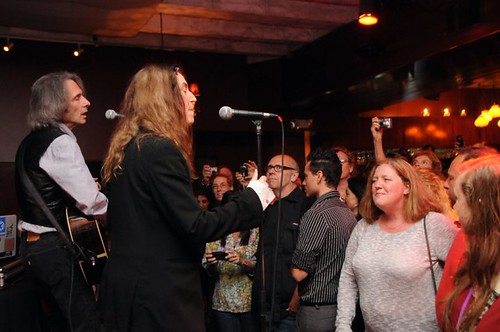
It was an event I was extremely proud to have helped organize and it was a flawless reading; the crowd was riveted by the story and performances and everyone seemed to really enjoy the experience. How could they not? It’s not every day you get to see that group of people on stage together, debuting a new work. And yet, in the grand scheme of the festival world, it didn’t really make any waves, which might be for the best; Sarasota continues to fly a little bit under the radar which is at once frustrating for me and probably for the best. The festival continues to be very special to me, and the intimacy we can achieve is only possible by keeping things, well, special. The up-close and personal experience of Queer was bested the following night when Patti Smith and Lenny Kaye serenaded the attendees at our festival’s President’s Dinner by strolling table to table and singing Beneath The Southern Cross. Everyone was awestruck, a feeling that carried over to the Late Night Party, where Patti and Lenny played a 70 minute acoustic set in a very small room, with a less than desirable sound system, and blew the crowd away.


Patti Smith and Lenny Kaye at The Sarasota Film Festival (photo by Mollie Grady)

Sarasota remains the cinematic love of my life. The program is a pure collaboration between Holly Herrick and me and that relationship remains, my family aside, one of the most important in my life. I love my job, I love my colleagues, I love the work, I am proud of the results. It never gets old. My relationships and passions are what makes it all worth doing. I’m honored to be able to work on what I love; it is a luxury I never take for granted. Onward to 2011.


You Shoulda’ Been There: Patti Smith at The Sarasota Film Festival

Previously
#10 Twitter! Argh!
#9 Jury Duty
#8 Otherwise Unavailable
#7 The Social Network at NYFF
#6 The Home Consumer, Finally
#5 And Everything Is Going Fine… At Slamdance
#4. Post Mortem at The New York Film Festival
#3. Greenberg at Burns Court
#2. Blue Valentine at Sundance

Memory Lane

Best Of The Decade
Top 10 of 2009
Top 10 of 2008
Top 10 of 2007
Top 10 of 2006
Top 10 of 2005
Top 10 of 2004